
Home / Insights / Business finance
How Promoters' Credit Histories Influence Business Borrowing
Many founders assume an incorporated entity insulates them from individual financial records. In reality, commercial underwriting closely scrutinises the personal credit profiles of promoters, partners, and key directors before sanctioning business debt.
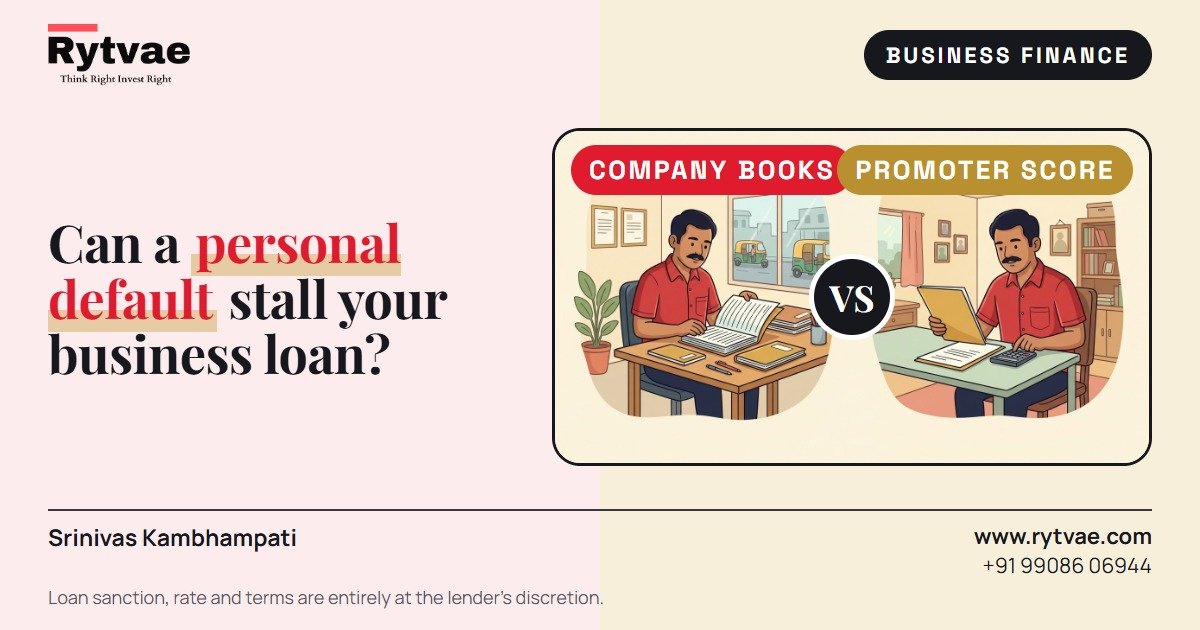
When expanding an enterprise or seeking working capital, business owners often assume that an incorporated company or partnership creates an impermeable boundary between company finances and personal credit records. A firm may present healthy top-line growth, steady cash flows, and audited balance sheets, only to find its loan proposal stalled during credit assessment.
In commercial credit evaluation, especially among small and mid-market enterprises, institutional lenders routinely examine the personal bureau records of promoters, directors, and partners. Understanding why institutional credit committees connect personal conduct with corporate debt helps business owners prepare effectively before approaching a financial institution.
The Underlying Rationale of Promoter Underwriting
Lenders operate under the fundamental principle that an enterprise is steered by its key decision-makers. In closely held private limited companies, limited liability partnerships, and proprietorships, operational decisions, cash distribution, and debt allocation remain concentrated in the hands of a few promoters. If an individual has a documented history of delayed repayments, restructured credit cards, or settled personal facilities, underwriters frequently perceive this behaviour as indicative of how commercial debt obligations might be handled under stress.
Institutional credit risk frameworks evaluate character, capacity, capital, collateral, and conditions. Personal credit history forms the foundation of the character assessment. A company may possess a distinct legal identity, but its willingness to honour commitments reflects the financial philosophy of its leadership. Consequently, commercial lenders rarely extend facility lines purely on commercial balance sheets without pulling individual credit bureau reports for all primary shareholders and operational directors.
Personal Guarantees and Direct Financial Linkages
In mid-corporate and SME lending across India, unsecured business term loans or secured working capital facilities generally require unconditional personal guarantees from key promoters. By signing a personal guarantee, a director or partner assumes joint and several liability with the enterprise. This contractual undertaking grants the lending institution legal recourse against personal assets if the corporate entity defaults on its obligations.
Because a personal guarantee exposes the lender directly to the individual guarantor's financial standing, the guarantor's debt profile becomes part of the credit underwriting process. Underwriters assess whether the promoter carries excessive unsecured debt, home loans, or contingent liabilities that could impair their ability to honour the guarantee. You can read more about how organizational structure influences debt requirements in our guide on business loan eligibility across different legal entities.
Commercial Bureau Data Versus Individual Credit Records
Commercial borrowing involves two distinct layers of credit bureau tracking. While an enterprise builds its own commercial credit history under its corporate identity, individual bureaus track promoter borrowing. Lenders systematically cross-examine both records to identify potential discrepancies or hidden leverage.
| Evaluation Dimension | Commercial Credit Record | Promoter Personal Credit Record |
|---|---|---|
| Primary Entity Evaluated | Proprietorship, Partnership, LLP, or Private Limited Company | Individual Promoter, Partner, or Key Director |
| Information Tracked | Commercial term facilities, cash credit, trade credit, and statutory filings | Retail loans, personal credit lines, vehicle loans, and credit cards |
| Underwriting Weight | Evaluates company cash flow, operating leverage, and debt-service capacity | Evaluates character, personal repayment discipline, and personal leverage |
| Remediation Path | Restructuring vendor dues, resolving balance sheet debt, and clearing charges | Resolving retail disputes, clearing overdue lines, and improving scores |
As demonstrated in the comparison, a flawless commercial credit score cannot compensate for severe blemishes on a promoter's personal profile. When underwriters uncover an active delinquency on an individual credit card or a settled retail personal loan, corporate applications are typically downgraded or declined regardless of enterprise profitability.
Specific Blemishes That Disrupt Loan Sanctions
Credit analysts pay particular attention to several specific red flags on individual reports. Understanding these concerns allows promoters to inspect their individual profiles before submitting enterprise funding requests:
- Written-off or Settled Accounts: When an individual negotiates a compromise settlement with a bank on a personal facility, the account is reported as settled rather than closed. Credit risk algorithms treat settled accounts as distressed debt, which typically halts commercial credit approvals until cleared.
- High Unsecured Personal Utilization: Promoters who carry high revolving balances on personal credit lines may appear cash-constrained. Underwriters may suspect that enterprise funds are being diverted to service individual commitments, or vice versa.
- Multiple Recent Inquiries: A surge in personal credit applications across multiple retail lenders over a short period indicates possible liquidity distress, triggering caution during commercial appraisal.
- Directorship in Delinquent Entities: If a promoter serves on the board of another business that has defaulted on institutional loans, that negative commercial record will often surface during promoter due diligence.
Enterprises looking to understand their overall risk parameters can benefit from undergoing a formal credit risk assessment to identify hidden vulnerabilities prior to debt origination.
Corrective Steps to Prepare for Institutional Borrowing
Prudent promoters manage their personal financial statements with the same rigor they apply to statutory audit books. If an enterprise anticipates seeking working capital lines, asset-backed term funding, or project finance over the coming year, promoters should initiate personal credit due diligence well in advance.
First, obtain detailed consumer credit reports for every promoter holding significant equity or management control. Review each trade line to verify that closed facilities reflect a clear zero balance and an appropriate closure status, rather than a settlement. If erroneous reporting or unrectified administrative mistakes appear, raise disputes with the relevant bureau and lending institution immediately, as resolution can take several weeks.
Second, separate corporate operational cash flows from personal living expenses. Avoid funding business shortfalls through expensive personal credit lines or informal personal borrowings, as these distort individual debt-to-income ratios. Third, pre-evaluate overall business eligibility by utilizing tools like a business loan eligibility analyzer to measure debt-servicing metrics objectively before facing a formal institutional committee.
By treating personal credit discipline as an essential business asset, promoters enhance enterprise borrowing capacity, improve the likelihood of smooth processing, and position their companies for constructive institutional lender relationships.
Frequently asked questions
Can a private limited company borrow without checking directors' personal credit?
Institutional lenders in India typically mandate promoter and director bureau checks for closely held private companies. Unless an enterprise is a widely held public firm with institutional governance, lenders require promoter scrutiny and personal guarantees.
How does a personal loan settlement affect a business loan application?
A settled status indicates that the borrower did not repay the contractually agreed amount in full. Commercial underwriters generally view settlements as a sign of past default, which often leads to an application decline until resolved.
Do all partners in a partnership firm need good credit scores for a loan?
Yes, because partners carry unlimited personal liability in a general partnership firm, lenders evaluate the credit history of all major partners. Negative reporting on any partner's bureau report can stall the firm's commercial sanction.
Will checking promoter credit scores hurt their individual credit profiles?
When a lender pulls a personal credit report during a formal commercial loan application, it is logged as an official credit inquiry. Multiple inquiries across several institutions within a brief span can temporarily depress a personal score.
Loan sanction, interest rate, tenure, charges and terms are entirely at the discretion of the lender and subject to its credit policy and documentation requirements. Rytvae Consulting does not sanction credit, does not guarantee approval and does not represent any specific lender's terms. This material is for general education only.
See our full disclosures and disclaimers.