
Home / Insights / Loans & credit
Rytvae Consulting — AMFI Registered Mutual Fund Distributor (ARN-265474), EUIN E091320
Business Loan Eligibility: How Lenders Evaluate Proprietorships, Partnerships, and Companies
Borrowing capacity and documentation requirements vary widely based on your enterprise structure. Learn how underwriters review sole proprietorships, partnerships, and incorporated companies.
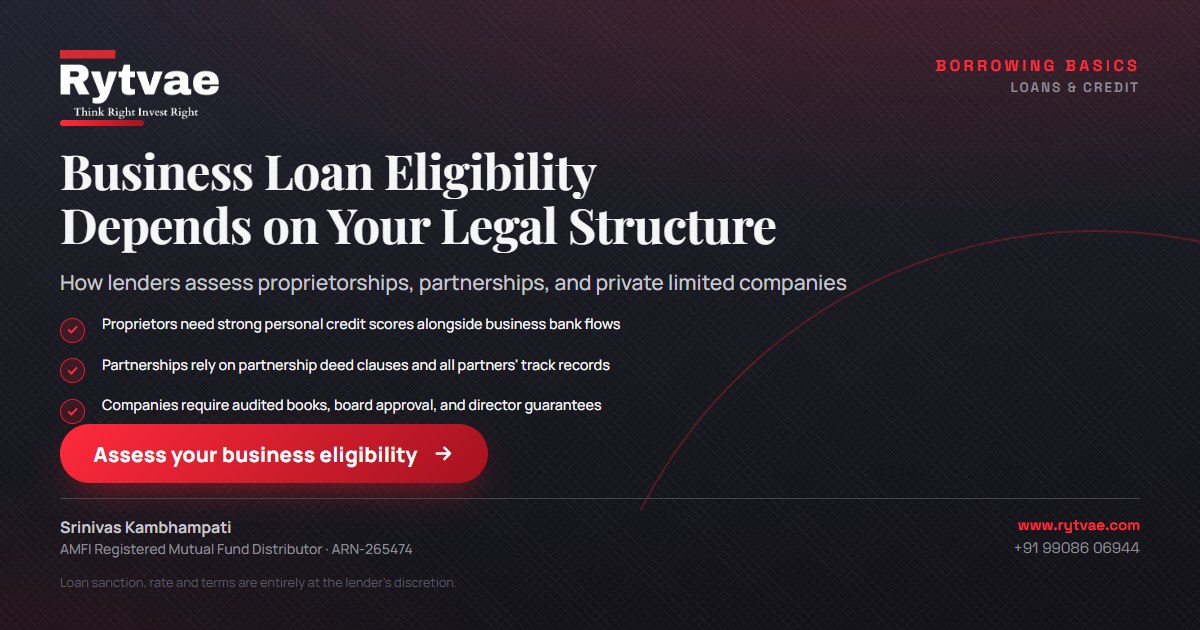
When you approach a formal lender to expand production, purchase inventory, or manage cash flow gaps, the conversation rarely starts with the strength of your product. Instead, credit teams immediately look at your legal constitution, your recorded bank turnover, and how liability is distributed among the individuals running the enterprise.
Many business owners assume that a healthy top line automatically translates into easy borrowing. However, a sole proprietor generating solid revenue can face rejection due to personal credit history, while an incorporated company with modest turnover might secure structured debt because of clear audited governance. Understanding how credit underwriters view your specific business structure helps you prepare the right records and set realistic borrowing expectations.
The Fundamental Distinction: Natural Persons vs. Separate Legal Entities
In Indian commercial lending, the first assessment is whether the business has an independent legal personality. A sole proprietorship has no legal existence separate from the individual proprietor. Consequently, the business loan is essentially an extension of personal credit evaluated through commercial turnover. If a proprietor defaults, their personal assets, savings, and properties are directly exposed to recovery.
A partnership firm, governed by the Indian Partnership Act or the Limited Liability Partnership Act, distributes responsibility among two or more partners. While an LLP provides limited liability to its partners, traditional unregistered or registered partnership firms carry unlimited personal liability. Lenders treat the combined personal net worth and credit standing of the active partners as central to the sanction decision.
In contrast, a private limited company is an autonomous corporate body incorporated under the Companies Act. The company owns its assets, enters contracts, and incurs liabilities. Even so, lenders almost universally mandate personal guarantees from promoter-directors for small and medium enterprise facilities to mitigate the barrier of limited corporate liability. To evaluate where your enterprise stands before presenting your proposal, utilizing a Business Loan Eligibility & Credit Analyzer provides clarity on institutional criteria.
Underwriting Criteria for Sole Proprietorships
For proprietorships, lenders look for sustained cash flows through a dedicated current account and consistent filing of income tax returns. Because personal and enterprise finances frequently intermingle, underwriters pay meticulous attention to bank account conduct.
- Banking turnover and average balance: Lenders scrutinize twelve months of primary current account statements. They check for consistent credit summations, minimum cheque bounces, and healthy average monthly balances relative to requested loan repayments.
- Personal credit score: Because the business cannot be separated from the individual, the proprietor's personal credit bureau score is paramount. Past delays on personal credit cards or vehicle loans directly impair the business application.
- Business vintage and proof of establishment: Proof of commercial continuity typically requires Goods and Services Tax (GST) registration, Udyam registration, Shop and Establishment certificates, or trade licenses showing at least two to three continuous years of operation.
- Taxation and cash profitability: Lenders rely on computation of income sheets and filed tax returns over consecutive years to calculate Debt Service Coverage Ratio (DSCR), verifying that net profits cover existing and proposed debt obligations.
Underwriting Criteria for Partnership Firms and LLPs
When assessing partnership firms, lenders must verify not only cash generation but also the legal authority of the partners to borrow on behalf of the business. Lenders undertake detailed scrutiny of the constitutional documents governing the firm.
- Partnership deed clauses: The deed must explicitly empower the managing partners to borrow money, pledge assets, and execute loan documents. Lenders verify whether all partners must sign jointly or if specific partners possess delegated borrowing powers.
- Credit profiles of all partners: The credit history of each active partner is reviewed. A severe default by even one majority partner can derail an application, as credit policies guard against internal promoter disputes affecting debt servicing.
- Firm registration status: While Indian law permits unregistered partnerships, formal commercial banks strongly prefer registered partnership deeds or Registrar of Companies (ROC) certificates for LLPs to ensure legal enforceability in dispute resolution.
- Capital contribution and profit-sharing stability: Lenders review whether capital remains invested in the firm or if partners withdraw excessive funds as drawings, which can undermine liquidity during slow operating cycles. A formal Credit Risk Assessment can reveal whether high partner drawings threaten working capital headroom.
Underwriting Criteria for Private Limited Companies
Corporate borrowers operate under rigorous governance frameworks. While this involves substantial documentation, it also allows companies to access sophisticated debt structures, such as structured term loans, letters of credit, and customized credit lines.
- Audited financial statements: Companies must provide complete audited balance sheets, profit and loss statements, schedules, and statutory auditor reports for consecutive financial years. Underwriters analyze gross margins, operational efficiency, and capital structure.
- Board resolutions and borrowing limits: Under the Companies Act, borrowing requires a formal board resolution. If total borrowings exceed prescribed thresholds relative to paid-up capital and free reserves, shareholder approval via a special resolution is verified.
- Ministry of Corporate Affairs (MCA) records: Lenders verify the company's master data, existing active charges on assets, authorized share capital, and director identification numbers (DIN). Prior encumbrances must be reconciled through satisfactory no-objection certificates or satisfaction-of-charge filings.
- Director personal guarantees: While corporate assets serve as primary security, lenders routinely obtain unconditional personal guarantees from executive directors. This ensures management commitment matches company liability.
Comparing Eligibility Criteria Across Business Types
The following table outlines how standard lending parameters differ across these three operating models:
| Evaluation Parameter | Sole Proprietorship | Partnership Firm / LLP | Private Limited Company |
|---|---|---|---|
| Legal Identity | Identical to the proprietor | Combined identity of partners (LLP has corporate status) | Separate legal corporate entity |
| Primary Financial Documents | ITR with computation, GST returns, 12 months current account statements | Firm ITR, balance sheets, partner ITRs, 12 months bank statements | Audited financials, schedules, tax audit reports, MCA filings, 12 months bank statements |
| Credit Score Dependence | Entirely dependent on proprietor's personal credit bureau score | Firm commercial score plus individual scores of all key partners | Company commercial bureau report plus director personal bureau scores |
| Promoter Liability | Unlimited personal liability across all personal assets | Joint and several unlimited liability for partners (limited for LLPs) | Limited by shares, but practically reinforced via director personal guarantees |
| Constitutional Authority | Trade license, Udyam certificate, GST registration | Registered partnership deed or LLP agreement authorizing borrowing | Memorandum & Articles of Association, board resolution, shareholder approval |
Aligning Your Debt Needs with Operating Cash Flows
Meeting baseline eligibility criteria is only the first step; structuring the loan appropriately is equally critical. For instance, selecting long-term debt to address short-term working capital shortfalls can lead to balance sheet friction. Exploring whether your cash cycle calls for revolving limits or receivables finance is essential; our guide on CC/OD or Invoice Discounting: Which Fits Your Cash Cycle provides an operational breakdown of these facilities.
By ensuring your legal documents, tax filings, and banking flows accurately mirror your entity's operational health, you can approach lenders with confidence, reducing turnaround time and securing debt terms matched to your business needs.
Frequently asked questions
Can a sole proprietorship get a business loan if the owner has a poor personal credit score?
It is very difficult because a proprietorship has no legal existence separate from the owner. Lenders view the proprietor as the sole borrower, meaning personal loan defaults directly impact commercial eligibility.
Why do banks demand personal guarantees from directors of a private limited company?
Although incorporated companies have limited liability, lenders use personal director guarantees to prevent promoters from walking away from company debts. The guarantee gives the lender recourse against personal assets if the corporate entity defaults.
Does an unregistered partnership deed hold valid eligibility for bank finance?
Most institutional lenders require a registered partnership deed or an LLP agreement registered with the Registrar of Companies. An unregistered deed creates legal complications in recovering dues, leading institutional credit teams to decline the file.
How many years of business vintage do lenders usually require?
Lenders typically look for a minimum of two to three continuous years of operational history, supported by filed income tax returns, GST certificates, and bank statements showing consistent revenue.
Rytvae Consulting — AMFI Registered Mutual Fund Distributor (ARN-265474), EUIN E091320. Loan sanction, interest rate, tenure, charges and terms are entirely at the discretion of the lender and subject to its credit policy and documentation requirements. Rytvae Consulting does not sanction credit, does not guarantee approval and does not represent any specific lender's terms. This material is for general education only.
See our full disclosures and disclaimers.