Home / Insights
Rytvae Consulting — AMFI Registered Mutual Fund Distributor (ARN-265474), EUIN E091320
Investor-awareness notes and plain-English explainers on rule changes, tax and protection — plus the updates we post to our Google Business Profile. We report and explain what changed; we do not forecast markets or recommend schemes.

An examination of behavioral finance in India, contrasting disciplined retail SIP flows with speculative F&O losses, as highlighted by SEBI and AMFI data.

Explore how systematic investment plans (SIPs), step-up mechanisms, and current Section 112A capital gains tax rules shape long-term wealth creation in India.
An analytical review of India's macroeconomic indicators, RBI policy stance, infrastructure multiplier effects, and fixed-income market transmission dynamics.

An analytical exploration of NSE Nifty 50 market valuation multiples, historical bands, and the critical distinction between consolidated and standalone earnings for long-term asset allocation.

Explore essential retirement corpus calculations, life-stage financial planning, and the power of compounding to secure your financial future in India.
A comprehensive educational guide on structuring 6-12 months of emergency cash buffers, separating pure term insurance from investments, and maintaining nomination hygiene under SEBI and AMFI guidelines.
A comprehensive guide on maintaining robust emergency cash buffers, separating pure term insurance from investments, and maintaining foolproof nomination hygiene.
An analytical guide to market valuation metrics, consolidated vs standalone earnings, and how asset allocation cushions long-term portfolios.
A deep dive into Price-to-Earnings ratios, historical valuation bands, consolidated earnings vs standalone metrics, and why long-term asset allocation beats short-term market timing.
An in-depth analysis of India
Brent crossed $91 a barrel on 18 August 2026 as a US–Iran ceasefire lapsed. India imports roughly 85% of its crude. Here is the chain of transmission from a barrel of oil to your own portfolio.
Discover how increasing your monthly SIP contribution annually in tandem with salary increments can double your final wealth accumulation compared to a flat SIP.
Why quarterly financial disclosures, operating margin trends, and management guidance dictate long-term fund positioning beyond short-term stock price noise.
USD/INR traded near 95.45 in mid-August 2026 as oil prices climbed and the dollar firmed. A weaker rupee is not a single event with a single consequence — it is four separate effects on four parts of your finances.
How the Reserve Bank of India
Daily FII and DII figures are among the most quoted and least understood numbers in Indian markets. What they measure, what they do not, and why a foreign outflow is no longer the whole story.
A comprehensive guide to mutual fund capital gains taxation in India: Long-Term vs Short-Term definitions, grandfathering provisions, and tax-efficient redemption planning.
Tariff announcements have moved Indian markets repeatedly since 2025. What a tariff actually is, which parts of the economy it touches, and why services exports have been comparatively insulated.

Why investor behavior—not market performance—is the primary determinant of long-term returns, and how to build psychological guardrails against market noise.
AMFI data for July 2026 shows SIP contributions at a four-month high of ₹31,961 crore, up 12.3% year on year, even as active equity inflows moderated 15% month on month. Reading the two together.
An analytical breakdown of SEBI
How decisions by the world
How international corporations are diversifying manufacturing hubs beyond China, and how India
The foundational rule of personal finance: how to calculate your true monthly living expenses, where to park emergency cash for safety and liquidity, and why protection comes before compounding.
The mathematical framework for calculating your true retirement corpus, accounting for 6% inflation, healthcare costs, and 30+ years of post-retirement living.
The MPC voted unanimously to hold the repo rate on 5 August 2026. What a pause means mechanically for EMIs, deposit renewals and debt funds.

From 1 April 2026 a new income tax law replaced the 1961 Act. Rates did not change; the vocabulary did. What to expect at filing time.
A rebate is not a slab. Understanding the difference explains why the zero-tax figure changes depending on who is quoting it.
The 1996 mutual fund regulations were replaced after nearly thirty years. For most unit holders the effect is disclosure, not disruption.

SEBI’s February 2026 categorisation circular raised minimum equity for some categories and capped portfolio overlap. What that means for a fund you already hold.
Retirement and children’s funds have been restructured into Life Cycle Funds with a target maturity and a fixed glide path. How the structure works.
Costs are now disclosed as a Base Expense Ratio plus separately itemised charges. Comparing a new figure with an old one needs care.
AUM, net inflows and SIP contribution get compressed into one headline. Reading them separately is more useful than reading the headline.

Every financial journey begins with understanding your goals before making any investment decision. Understand before you invest, define your goals, know the risks that come with each option, and give the plan time to work.
More SIP accounts ended than started in March and April 2026, while SIP money stayed at record levels. Both facts are true — here is why.
Assured returns, WhatsApp groups and unregistered intermediaries. The warning signs of investment fraud, and the official grievance routes that work.
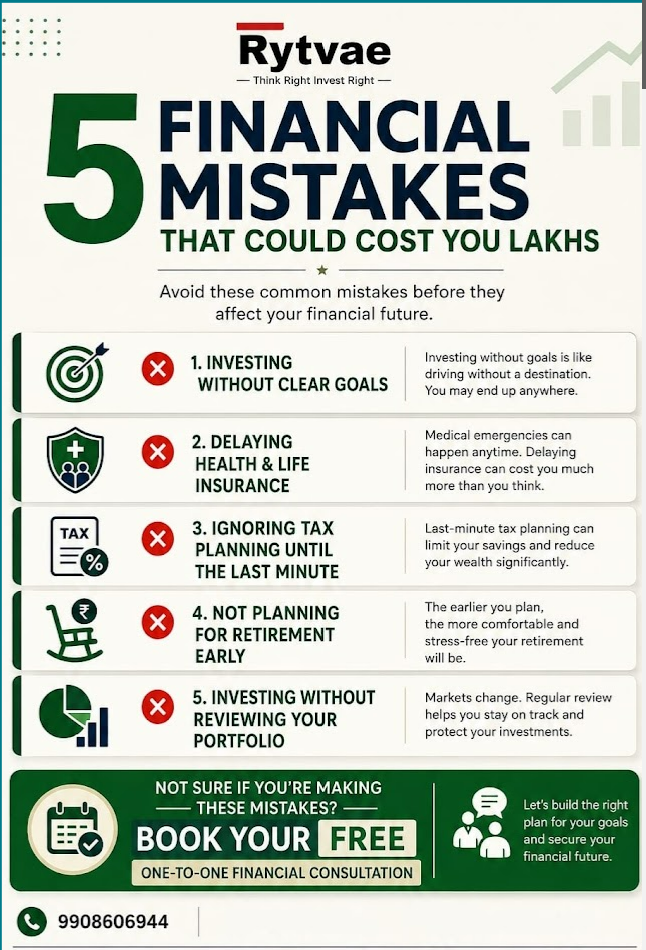
Investing with no clear goal, delaying health and life cover, leaving tax to the last minute, putting off retirement saving, and never reviewing your portfolio. Five common habits, and what each one quietly costs you.

Mutual fund guidance, insurance, tax, retirement and business consulting — handled together rather than in pieces, so decisions in one area do not quietly undo another.
Raising your monthly investment by just 10% a year tracks your salary growth and can materially change where you finish. Here is the arithmetic, without the jargon.
Every year clients scramble in March. Keep these three statements handy — ELSS proof, capital gain statement and your consolidated account statement — and filing takes minutes.
A common order-of-operations mistake. Before you compound anything, make sure one setback cannot undo a decade of saving for your family.
No posts match this search or category filter.
Every update posted to our Google Business Profile also lands here. Follow the profile to get them in your feed, or leave a review while you are there.
Rytvae Consulting — AMFI Registered Mutual Fund Distributor (ARN-265474), EUIN E091320. Rytvae Consulting is a distributor of mutual fund and insurance products and is not a SEBI-registered Investment Adviser. Any assistance offered is incidental to distribution.
Content on this page is published for investor awareness and general information only. It is not investment, tax or legal advice, and it is not a recommendation, offer or solicitation to buy or sell any scheme or security. Nothing here should be read as a view on where markets are headed.
Where any figure or illustration appears, it is hypothetical and for explanation only. Past performance may or may not be sustained in the future and is not a guarantee of future returns. No return is assured or guaranteed. Data, news and reports referred to are credited to their source at the point of use.
Mutual fund investments are subject to market risks. Read all scheme-related documents carefully before investing. Investors should assess their own circumstances, or consult a SEBI-registered Investment Adviser or a qualified tax professional, before acting on anything read here. See our full disclosures and disclaimers.