
Rytvae Consulting — AMFI Registered Mutual Fund Distributor (ARN-265474), EUIN E091320
Indemnity Versus Fixed-Benefit Health Insurance: How They Differ and Work Together
Medical emergencies bring two distinct financial burdens: hospital bills and lost income. Learn how indemnity and fixed-benefit health insurance policies address these separate risks.
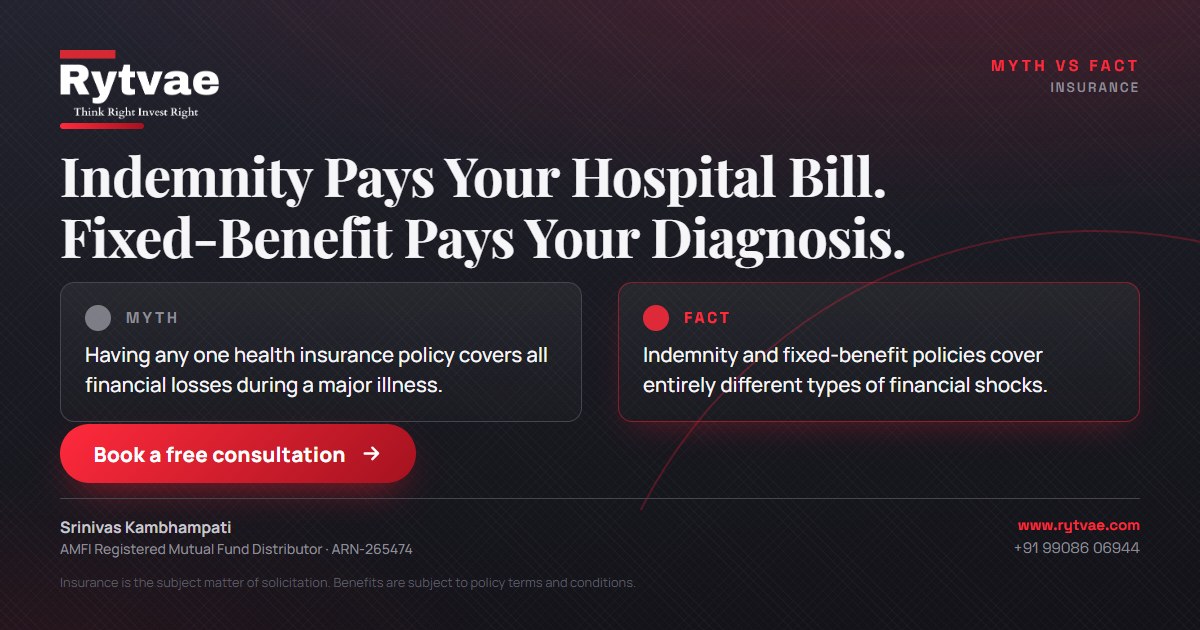
When a family member faces a sudden hospitalization, the stress of the medical crisis is immediately compounded by financial worry. Many households assume that purchasing any standard health insurance policy will automatically cover every single cost that arises during the treatment. In practice, however, medical emergencies create two very different types of financial strain.
The first strain is the direct cost of medical care, including room rent, surgeon fees, diagnostics, and medicines. The second strain is indirect, such as lost income while a primary earner is recovering, travel expenses for family members, and lifestyle adjustments required at home. Relying on a single type of insurance policy often leaves one of these areas exposed. To build robust protection, you need to understand how indemnity health insurance and fixed-benefit health insurance operate as distinct tools.
How Indemnity Health Insurance Works
Indemnity health insurance is the foundation of almost every household medical safety net. When you purchase an indemnity policy, the insurer agrees to pay for actual medical expenses incurred during hospitalization, up to the maximum limit of your sum insured. If your hospital bill amounts to a specific figure, the insurer settles that exact amount directly with the network hospital through cashless processing, or reimburses you if you pay out of pocket.
These policies are designed specifically to absorb the direct costs of medical treatment. However, they do not hand you extra cash for incidental expenses. Furthermore, indemnity plans are governed by specific clauses such as room rent limits, co-pay requirements, and waiting periods. Understanding these operational mechanics is vital, and you can explore the nuances further in our guide on Room Rent, Co-pay and Waiting Periods Explained.
Because indemnity plans only pay for actual bills submitted with hospital discharge summaries and itemized invoices, they do not compensate for the wages you lose while away from work. This limitation is precisely where fixed-benefit health insurance enters the picture.
How Fixed-Benefit Health Insurance Works
Fixed-benefit health insurance operates on an entirely different principle. Instead of reimbursing actual hospital bills, a fixed-benefit policy pays out a pre-determined lump sum of money upon the occurrence of a specific, defined event, such as the diagnosis of a critical illness or a personal accident resulting in specific disabilities.
The insurer does not ask for hospital bills, pharmacy receipts, or itemized statements. Once the medical criteria outlined in the policy wording are officially diagnosed and verified, the full sum insured under that specific benefit contract is transferred to you. You have complete autonomy over how to use those funds.
You can use the payout to replace lost household income during a long recovery, pay off existing debts so your family is not burdened, hire specialized nursing care at home, or fund experimental treatments that standard plans might scrutinize. This makes fixed-benefit policies a powerful complement to your primary indemnity cover, functioning similarly to how a personal accident or term life policy provides dedicated income replacement during a crisis.
Comparing Indemnity and Fixed-Benefit Plans
To see how these two structures differ in practice, it helps to review their core operational mechanics side by side.
| Feature | Indemnity Health Insurance | Fixed-Benefit Health Insurance |
|---|---|---|
| Primary Purpose | To pay actual hospital bills | To provide a lump sum on diagnosis |
| Payout Basis | Actual expenses incurred | Pre-decided sum regardless of bills |
| Bill Submission Required? | Yes, itemized bills and discharge summary | No, only medical diagnosis proof |
| Usage of Funds | Restricted to hospital and medical expenses | Unrestricted; can replace lost income or pay debt |
| Impact of Multiple Policies | Claims are coordinated or shared | All policies pay out fully upon diagnosis |
Integrating Both Into Your Household Plan
Building a resilient financial foundation for your family requires looking beyond single-product solutions. Just as an emergency fund and term life cover work together to protect your household from income shocks, combining indemnity and fixed-benefit health insurance addresses both the hospital bill and the downstream lifestyle impact.
When reviewing your protection setup, ensure your core indemnity cover is adequate for modern medical inflation in your city. Then, consider whether adding a critical illness rider or a standalone fixed-benefit plan is necessary to protect your household income if a major diagnosis forces a long break from work. You can evaluate your broader financial readiness by exploring our resources on Building Unbreakable Wealth Foundations: Emergency Funds, Term Cover & Hygiene.
Every family's health history, existing savings, and current liabilities are unique. Taking the time to map out these requirements methodically ensures that when a medical event occurs, your financial plan holds firm. If you would like to review your current insurance structure or discuss how these different policies fit into your overall financial plan, you are welcome to Contact Rytvae Consulting — Book a Free Consultation | Bangalore.
Frequently asked questions
Can I claim from both an indemnity health policy and a fixed-benefit policy for the same hospitalization?
Yes, because they operate on different principles. Your indemnity policy will settle the actual hospital bills up to its limit, while your fixed-benefit policy will pay out its full lump sum upon diagnosis regardless of what the indemnity insurer paid. They do not conflict with each other.
Do fixed-benefit health insurance policies require me to submit hospital bills?
No, fixed-benefit plans do not require hospital bills or medical expense receipts. They pay the predetermined lump sum as long as the medical condition meets the specific diagnostic criteria and definitions outlined in your policy wording.
Is indemnity health insurance alone enough to protect my family's finances?
While indemnity insurance is essential for paying hospital bills, it does not replace lost income if you or an earning member cannot work for months during recovery. Many families pair indemnity cover with fixed-benefit critical illness plans or term insurance to cover income replacement.
How do I decide the right sum insured for indemnity versus fixed-benefit plans?
The right amount depends on your city of residence, local hospital costs, family medical history, and existing financial liabilities. An indemnity cover should reflect typical major hospitalization costs, while a fixed-benefit plan should reflect several months of household living expenses and income replacement.
Rytvae Consulting — AMFI Registered Mutual Fund Distributor (ARN-265474), EUIN E091320. Insurance is the subject matter of solicitation. The benefits described are indicative and are governed entirely by the policy wording, terms, conditions and exclusions of the issuing insurer. Please read the policy document before concluding a sale. Rytvae Consulting acts as a distribution intermediary and does not underwrite risk or settle claims.
See our full disclosures and disclaimers.