
Home / Insights / Loans & credit
Understanding How Lenders Assess Business Vintage for Commercial Credit
When you apply for commercial financing, lenders scrutinise your business vintage. Learn why incorporation dates alone are insufficient and how underwriters verify genuine operational continuity through taxes, banking, and statutory filings.
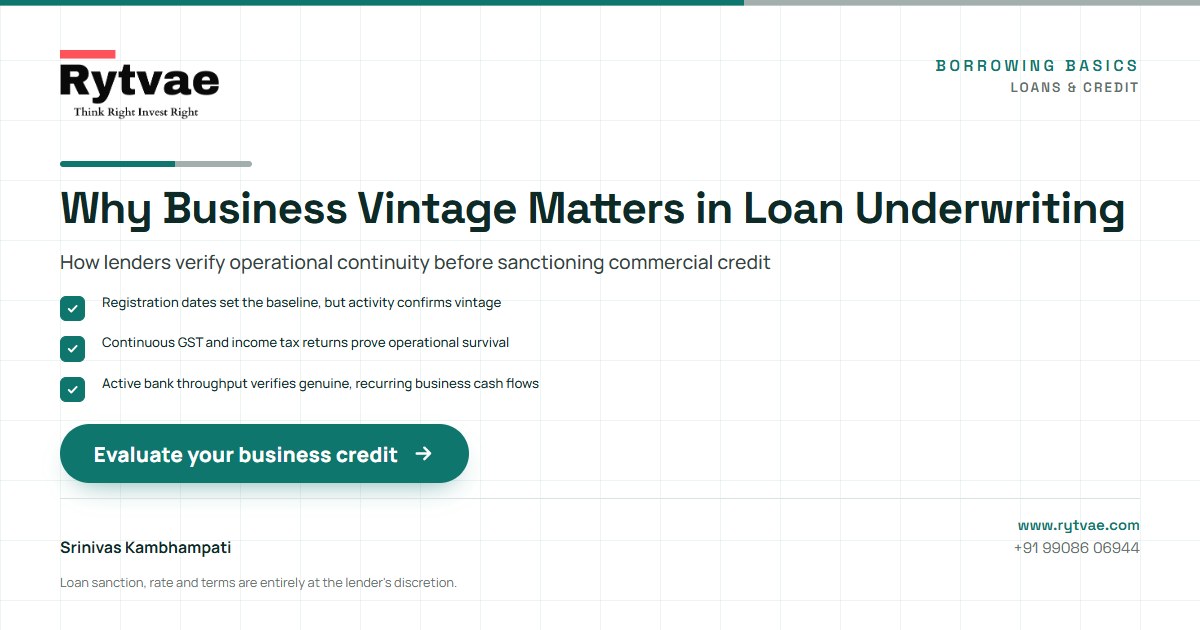
When you approach a financial institution for working capital or expansion funding, you may discover that your company registration date tells only part of the story. Many entrepreneurs discover during the credit appraisal stage that a certificate of incorporation issued three years ago does not automatically give them three years of accepted vintage.
Underwriters look beyond legal formation to determine whether an enterprise has established authentic commercial resilience. Lenders must verify whether your operations have functioned continuously through diverse economic conditions, settled contractual obligations on time, and maintained genuine transaction flows.
The Fundamental Distinction Between Legal Age and Operational Vintage
Legal age refers strictly to the calendar time elapsed since your entity received its foundational registration, such as an incorporation certificate from the Registrar of Companies or a formal partnership deed. While necessary, legal age alone does not demonstrate commercial viability. A shell company or an inactive entity can hold an incorporation certificate for several years without executing a single trade.
Operational vintage measures active commercial existence. It tracks the period during which an enterprise produced goods or delivered services, received customer payments, settled vendor invoices, and met payroll requirements. Credit underwriters prioritise operational vintage because it offers verifiable evidence that the promoter team understands working capital management and market cycles.
When assessing eligibility, institutional underwriters cross-check statutory data with internal parameters to identify operational gaps. To see how these expectations align with your current financial profile, you can review our Business Loan Eligibility & Credit Analyzer.
The Core Documents Lenders Use to Verify Vintage
Lenders do not rely on self-declarations to establish continuity. Instead, they request multiple corroborating public records and financial trails that establish uninterrupted operations over time.
- Statutory Tax Filings: Consecutive years of Income Tax Returns (ITR), accompanied by audited balance sheets and profit and loss accounts, serve as primary baseline documents. An unbroken chain of annual filings establishes fiscal continuity.
- Indirect Tax Compliance: Monthly or quarterly Goods and Services Tax (GST) returns illustrate current turnover trends. Underwriters compare GST turnover against reported income tax revenues to verify trade consistency.
- Primary Current Account Statements: Consistent banking throughput over twelve to thirty-six months confirms everyday commercial activity. Inactive accounts, erratic deposits, or sudden influxes of funds right before a loan application raise underwriting concerns.
- Licences and Utility Records: Factory licences, municipal trade permits, Shops and Establishment Act registrations, and continuous utility bills demonstrate that physical premises have remained functional over the stated period.
How Lenders Evaluate Different Legal Structures
The documentation requirements for establishing vintage vary depending on whether you operate as a sole proprietorship, a formal partnership, or an incorporated company. For a detailed breakdown of legal setups, consult our guide on business loan eligibility across proprietorships, partnerships, and companies.
| Business Structure | Primary Document for Legal Age | Core Proof of Active Operations | Common Vintage Verification Hurdle |
|---|---|---|---|
| Sole Proprietorship | Udyam registration, Shop Act, GST certificate | Continuous current account banking, ITR with business schedules | Lack of formal registration date prior to opening bank accounts |
| Partnership Firm | Registered partnership deed, firm registrar certificate | Audited partnership accounts, consecutive partner tax returns | Deed revisions or partner reconstitution resetting operational clock |
| Private Limited Company | Certificate of Incorporation issued by MCA | Audited statutory statements, MCA annual filings (AOC-4, MGT-7) | Dormant periods between incorporation and capital deployment |
Sole proprietorships often face specific scrutiny because an individual may operate informal trading activities for years before registering a formal trade licence. For unincorporated firms, lenders usually date vintage from the earliest verifiable government document or the opening date of the primary commercial current account.
Why Operational Continuity Matters in Credit Risk Assessment
Lenders evaluate vintage primarily to price credit risk. An enterprise with several years of steady operations has demonstrated its ability to survive standard inventory bottlenecks, seasonal demand dips, and debtor defaults. This survival history helps lenders model future repayment stability.
During a comprehensive credit risk assessment, credit officers measure business stability against specific benchmarks:
- Revenue Stability: Multi-year operational data allows underwriters to assess whether turnover is growing sustainably or swinging unpredictably between quarters.
- Cash Flow Predictability: Active operating histories show whether receivables are collected predictably or tied up in persistent disputes.
- Banking Discipline: Longer bank statement histories provide credit committees with insight into inward cheque returns, ECS debit failures, and average minimum balances.
Navigating Business Restructuring and Name Changes
Many growing enterprises undergo structural transformations, such as converting a sole proprietorship into a partnership or corporatising into a private limited company. When these changes occur, promoters often worry that their operational vintage will be reset to day one.
Most institutional credit policies permit vintage succession if continuity of ownership, management, and underlying operations can be established. To carry forward your operational track record after an entity conversion, you generally need to provide:
- A clear legal succession clause in the new partnership deed or company formation documents.
- Proof of asset and liability transfer from the earlier entity to the new corporate vehicle.
- Overlap of key promoters holding controlling equity or capital contributions.
- Unbroken customer and vendor contracts spanning the transition period.
- Past tax records of the predecessor entity tied to the current entity through closing financial statements.
If these historical connections are documented transparently, lenders can often count the predecessor entity's operational history toward minimum vintage requirements, preserving your eligibility for competitive credit facilities.
Frequently asked questions
What is the difference between business age and business vintage?
Business age is the calendar time since your business was legally incorporated or registered. Business vintage refers to the period during which the enterprise has actively generated revenue, processed banking transactions, and fulfilled statutory tax obligations.
Can I get a business loan if my company was incorporated recently but I have run the business for years?
Yes, lenders can often consider past operational history if you transitioned from a proprietorship or partnership into a corporate entity. You will need to provide documented proof of operational succession, common promoter ownership, and continuous banking history.
What happens if there is an operational gap in my business tax filings?
A break in consecutive tax filings or extended periods of zero turnover can cause underwriters to reset your accepted operational vintage. Lenders require consistent, ongoing activity to verify commercial stability and regular debt-servicing ability.
Does a current account opening date establish business vintage?
For proprietorships and informal structures, lenders frequently treat the opening date of the primary commercial bank account as the inception point of active business operations, especially when initial registration records are unavailable.
Loan sanction, interest rate, tenure, charges and terms are entirely at the discretion of the lender and subject to its credit policy and documentation requirements. Rytvae Consulting does not sanction credit, does not guarantee approval and does not represent any specific lender's terms. This material is for general education only.
See our full disclosures and disclaimers.