
Home / Insights / Business finance
Rytvae Consulting — AMFI Registered Mutual Fund Distributor (ARN-265474), EUIN E091320
Business Term Loans Versus Working-Capital Facilities
When your business needs external funding, choosing between a term loan and a working-capital facility depends on whether you are acquiring fixed assets or managing daily operating cycles.
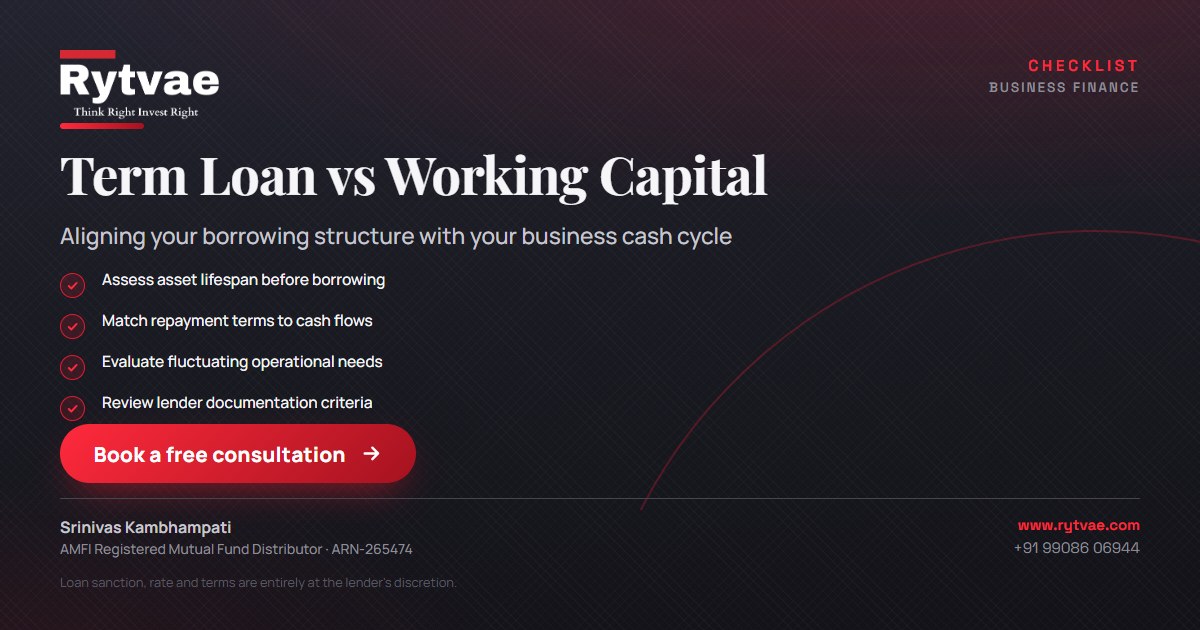
When running a growing business, managing cash flow effectively is a constant priority. You might find yourself needing funds to purchase new machinery, expand your warehouse, or simply pay suppliers while waiting for customer payments to clear.
However, picking the wrong type of credit can strain your cash flow. A facility designed for long-term investments does not solve a short-term operational shortfall, just as a revolving short-term credit line is not suited for financing heavy capital equipment.
Understanding Business Term Loans
A business term loan provides a lump sum of capital that you repay over a fixed schedule with regular instalments. Lenders generally evaluate your long-term earnings, balance sheet strength, and the economic viability of the project you intend to fund.
Because term loans are structured for longer durations, they are typically used for capital expenditure. This includes buying commercial real estate, upgrading manufacturing plants, or acquiring expensive machinery that will generate revenue over many years. The repayment schedule is designed to align with the extended economic life of the asset being acquired.
The Role of Working-Capital Facilities
In contrast, working-capital facilities are designed to fund the day-to-day operations of your business. If your company experiences a gap between paying for raw materials and receiving payments from clients, your operational cash flow can freeze, even if your order book is full.
Working-capital facilities often take the form of revolving credit lines, overdrafts, or bill discounting arrangements. They allow you to draw funds as needed, pay interest only on the utilized amount, and clear the principal as your receivables are realized. For a deeper look at how short-term transaction financing works, you can review our guide on CC/OD or Invoice Discounting: Which Fits Your Cash Cycle.
Core Structural Differences
Evaluating how these two funding mechanisms differ helps clarify which option fits your immediate business requirement. Term loans provide a one-time injection of capital for specific milestones, whereas working-capital facilities remain flexible to absorb the seasonal fluctuations of your business cycle.
| Feature | Business Term Loan | Working-Capital Facility |
|---|---|---|
| Primary Purpose | Capital expenditure and expansion | Day-to-day operations and inventory |
| Disbursement | Lump sum | Revolving or need-based drawdowns |
| Tenure | Medium to long term | Short term, typically reviewed annually |
| Repayment | Fixed periodic instalments | Flexible based on cash receipts |
For businesses engaged in multi-stage commercial projects, funding is often drawn down in structured milestones rather than a single lump sum. To understand how staged funding operates in project environments, read more about Why Construction Finance Is Drawn in Stages.
Matching Credit to Your Business Cycle
Before approaching a lender, examine the exact nature of your cash shortfall. If you are funding an asset that will remain on your balance sheet for years, a term loan matches the revenue timeline of that asset. If you are facing a temporary mismatch between inventory purchases and debtor collections, a short-term working-capital line prevents you from locking into rigid, long-term repayment obligations.
At Rytvae Consulting in Bangalore, we help business owners analyse their financial structures, prepare accurate documentation, and navigate debt options responsibly. You can learn more About Rytvae Consulting | Srinivas Kambhampati, Bangalore, explore our full suite of offerings on our Our Services | Mutual Funds, Insurance, Loans, Planning page, or reach out directly through our Contact Rytvae Consulting — Book a Free Consultation | Bangalore portal.
Frequently asked questions
Can I use a working-capital facility to buy machinery?
Working-capital facilities are designed for short-term operational needs like inventory and payroll rather than long-term fixed assets. Purchasing heavy machinery is typically financed through a term loan or equipment financing, where the repayment tenure matches the useful life of the asset.
How do lenders evaluate applications for business loans?
Lenders review your financial statements, tax filings, banking history, and credit records to assess repayment capacity. Loan sanction, interest rate, tenure, charges and terms are entirely at the discretion of the lender and subject to its credit policy.
What is the primary advantage of a revolving working-capital facility?
A revolving facility allows you to draw funds and repay them as your cash receipts come in, meaning you pay interest only on the amount you actively use. This flexibility helps manage seasonal fluctuations in business revenue without locking you into fixed monthly instalments.
Rytvae Consulting — AMFI Registered Mutual Fund Distributor (ARN-265474), EUIN E091320. Loan sanction, interest rate, tenure, charges and terms are entirely at the discretion of the lender and subject to its credit policy and documentation requirements. Rytvae Consulting does not sanction credit, does not guarantee approval and does not represent any specific lender's terms. This material is for general education only.
See our full disclosures and disclaimers.