
Rytvae Consulting — AMFI Registered Mutual Fund Distributor (ARN-265474), EUIN E091320
Claim Settlement Ratios versus the Wording of an Individual Policy
A high claim settlement ratio is often treated as a guarantee of safety. In practice, claims are paid or repudiated based entirely on policy clauses, definitions, and the accuracy of your application form.
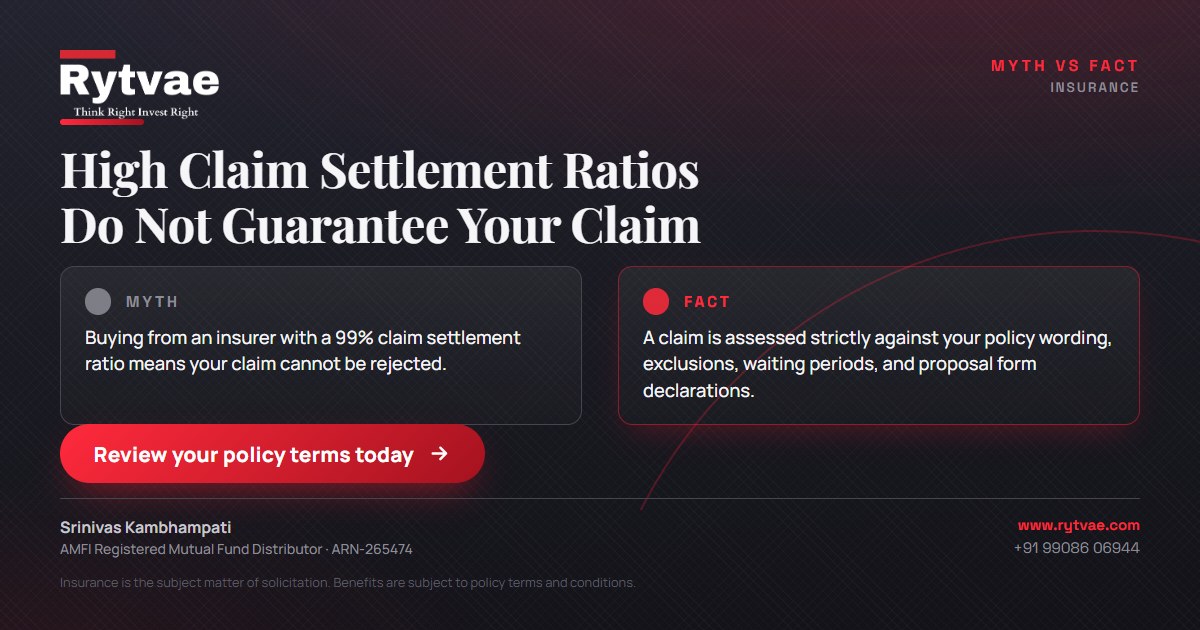
When buying life or health insurance, most buyers look at a single metric: the claim settlement ratio. A figure approaching ninety-nine percent creates an immediate sense of safety, encouraging the belief that choosing that insurer removes the risk of a rejected claim.
The reality at the hospital desk or during a nominee's claim filing is very different. An insurer does not settle a claim because its aggregate annual numbers are commendable. Every claim is adjudicated against the exact clauses, waiting periods, and definitions printed inside your specific contract.
What Aggregate Ratios Actually Measure
A claim settlement ratio measures the percentage of claims paid by an insurer out of the total claims received and pending during a financial year. It serves as a broad indicator of an insurer's administrative scale, processing speed, and institutional solvency.
However, an aggregate ratio reflects past claims across thousands of different contracts, underwriting vintages, and policy types. It does not assess the validity of your individual contract. If your claim falls within an exclusion or follows non-disclosure of a material medical condition, the insurer's corporate track record cannot compel a payout.
Relying on this single metric creates a false sense of security. It diverts attention from the fundamental legal contract, where claim outcomes are actually determined.
The Supremacy of Policy Wording
Insurance contracts are legal instruments governed by strict principles of contract law and insurance regulation. The rights of the policyholder and the obligations of the insurer are defined exclusively by the policy schedule and the terms and conditions attached to it.
When an assessment officer reviews an intimation, they examine several concrete elements:
- Inception dates and waiting periods: Certain illnesses, pre-existing conditions, or specific surgeries are excluded until a mandatory duration has elapsed.
- Specific definitions: Critical illnesses or medical events must meet the exact clinical criteria specified in the policy document, not just a general diagnostic label provided by a physician.
- Sub-limits and room rent caps: In health insurance, proportionate deduction clauses can reduce payout amounts across doctor fees and procedures if the chosen hospital room exceeds the contractual limit.
- Permanent exclusions: Standard exclusions, such as unapproved treatments, experimental procedures, or injuries sustained under specific high-risk activities, remain non-payable regardless of general company performance.
When selecting individual or Health Insurance & Family Floater in India, reading these specific definitions is far more protective than examining marketing brochures.
Why Claims Get Repudiated
Insurers repudiate claims when there is a mismatch between the event reported and the risks covered under the contract. The primary causes of repudiation rarely relate to the financial capacity of the insurer. Instead, they stem from standard operational and legal triggers.
The most common cause is non-disclosure or misstatement of material facts. Under the doctrine of utmost good faith, the applicant is legally obligated to disclose existing medical conditions, family medical history, lifestyle habits, and existing coverage with other insurers. Omitting a pre-existing condition, even unintentionally, can void the contract.
Another common cause is seeking coverage during an active waiting period or submitting a claim for a condition explicitly excluded under standard policy terms. When planning comprehensive protection through Life Insurance Plans in India, declaring all health markers and current policies accurately at the proposal stage ensures the policy remains legally robust when your family needs it most.
Comparing Aggregate Metrics with Contractual Terms
To understand why policy clauses take precedence, consider how institutional metrics compare against individual contract terms during assessment.
| Evaluation Parameter | Claim Settlement Ratio | Individual Policy Wording |
|---|---|---|
| Scope | Macro-level portfolio performance | Legally binding personal contract |
| Primary Purpose | Industry transparency and operational benchmarking | Defines exact coverage, limits, and exclusions |
| Legal Enforceability | None for an individual claim dispute | Binding on both insurer and policyholder |
| Claim Adjudication Role | Not referenced during claim assessment | The sole basis for approval or repudiation |
| Impact of Non-disclosure | Cannot override material concealment | Permits contract voidance or claim denial |
Building Genuine Claim Certainty
To ensure a claim is processed smoothly, policyholders should shift their focus from high-level statistics to personal administrative discipline.
First, complete the proposal form yourself or verify every single entry before signing or providing digital consent. Never allow an intermediary to mark medical questions as negative without reviewing your medical history. Disclose all past consultations, treatments, hospitalisations, and regular medications.
Second, examine the policy schedule during the statutory free-look period. Check that names, dates of birth, nominee designations, and declared conditions are printed accurately. If an insurer applies an underwriting loading or a specific waiting period, confirm that you understand and accept the condition.
Finally, keep your family informed about where physical and digital policy files are stored, how the intimation process works, and which hospital networks are empanelled. Conducting a structured Financial Health Check-Up | Nine-Point Annual Review helps identify gaps in documentation, nominee records, or coverage amounts before emergencies arise.
Frequently asked questions
Does a 98% claim settlement ratio mean my claim has a 98% chance of approval?
No. The ratio represents the proportion of aggregate claims settled by the insurer across all policyholders in a previous year. Your individual claim will be approved or rejected entirely on whether the event meets your contract's terms and accurate declarations.
What is the most common reason life and health insurance claims are rejected?
The primary reason is non-disclosure or misstatement of material facts in the proposal form. This includes failing to mention pre-existing illnesses, prior surgeries, habitual smoking, or existing insurance policies with other providers.
Can an insurer reject a claim if an illness falls inside a waiting period?
Yes. Most health policies include initial waiting periods for general illnesses, specific waiting periods for designated procedures, and waiting periods for pre-existing diseases. Claims occurring before these durations elapse are not payable under standard contract terms.
Rytvae Consulting — AMFI Registered Mutual Fund Distributor (ARN-265474), EUIN E091320. Insurance is the subject matter of solicitation. The benefits described are indicative and are governed entirely by the policy wording, terms, conditions and exclusions of the issuing insurer. Please read the policy document before concluding a sale. Rytvae Consulting acts as a distribution intermediary and does not underwrite risk or settle claims.
See our full disclosures and disclaimers.