
Rytvae Consulting — AMFI Registered Mutual Fund Distributor (ARN-265474), EUIN E091320
Critical-Illness Riders vs Standalone Policies: Understanding Structural Differences
A critical illness diagnosis creates two financial burdens: acute medical expenses and prolonged income disruption. Discover whether an attached life insurance rider or an independent standalone policy provides the most effective financial buffer for your household.
A serious medical diagnosis brings two distinct financial strains to a household. The first is direct medical treatment, which involves hospitalisation, surgical procedures, and post-operative monitoring. The second is prolonged indirect disruption, which includes months of income loss, travel for specialized therapy, lifestyle modifications, and ongoing domestic commitments that continue even when earnings pause.
Standard indemnity insurance, such as an individual cover or a health insurance and family floater, pays for hospital bills according to documented inpatient expenses. However, indemnity contracts do not compensate for lost earnings, ongoing living costs, or rehabilitation needs. To address this financial gap, individuals turn to critical illness protection. The choice usually narrows down to two structures: attaching a critical illness rider to a life insurance contract or buying an independent standalone critical illness policy. Understanding the operational differences between these options is essential before committing capital.
How Critical Illness Protection Differs From Regular Health Insurance
Before weighing riders against standalone policies, it is important to understand how critical illness cover works. Regular health insurance is an indemnity contract: the insurer reimburses hospital bills up to the approved limit or settles directly with the hospital network. If the final inpatient bill is lower than the sum insured, the policy pays only the billed amount.
A critical illness policy or rider operates on a defined-benefit mechanism. When the policyholder is diagnosed with a condition specified in the policy contract, and meets the stated medical criteria and survival periods, the insurer disburses a predetermined lump sum. The payout is made irrespective of actual hospital charges. The recipient can deploy this liquidity to settle mortgages, clear personal debts, pay for experimental treatment, or sustain routine household outlays during an extended recuperation period.
The Structure of a Critical Illness Rider Attached to Life Insurance
A critical illness rider is an optional add-on purchased alongside a primary policy, most commonly a pure term plan. You can explore how primary life covers are structured under life insurance plans. Riders are designed to offer basic supplemental protection without the administrative friction of maintaining a second contract.
Riders generally fall into two structural types: accelerated riders and additional (non-accelerated) riders.
In an accelerated rider, a claim for critical illness reduces the base life cover by the amount disbursed. If a term policy has a life cover of one crore rupees and an accelerated critical illness rider of twenty-five lakh rupees, a valid claim for a covered condition results in a twenty-five lakh rupee payout. Following this settlement, the remaining life cover drops to seventy-five lakh rupees. In contrast, an additional rider pays the critical illness sum insured as an independent lump sum, leaving the primary life coverage intact.
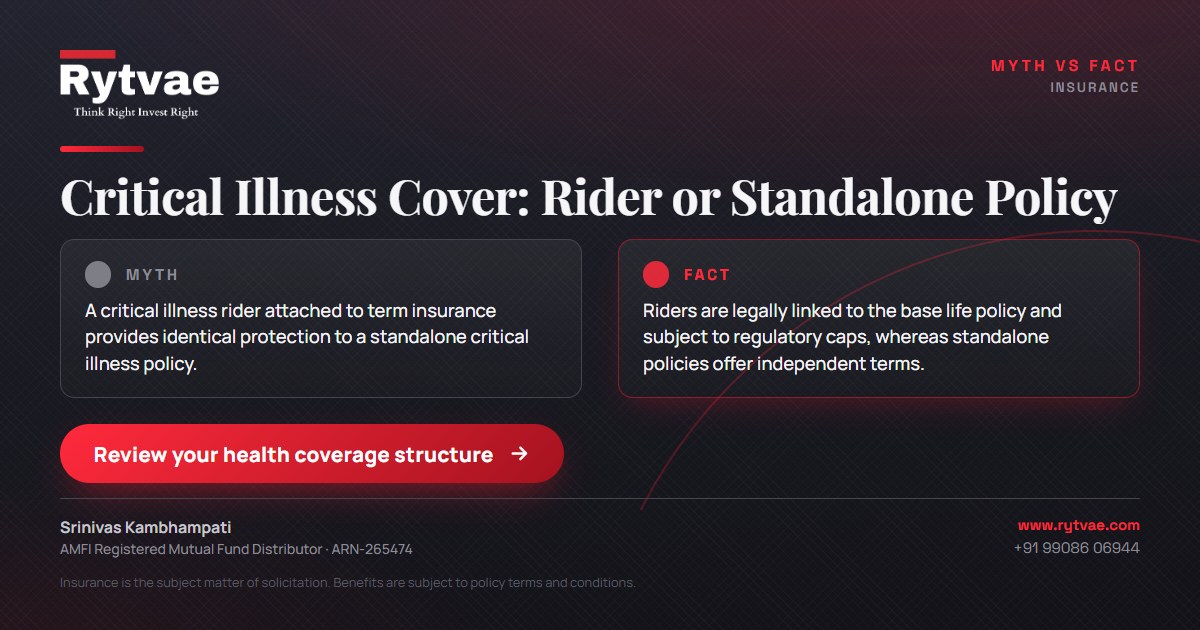
Riders offer clear conveniences. Premium administration is consolidated into one annual notice, underwriting is conducted concurrently with the base life proposal, and the recurring premium remains modest compared to purchasing a completely separate policy. However, riders carry systemic constraints. Regulatory provisions restrict rider premiums to a defined proportion of the base premium. Consequently, insurers often place hard ceilings on the rider sum insured, which may prevent an earner from securing a sufficiently large lump sum.
Standalone Critical Illness Policies: Complete Contractual Independence
A standalone critical illness policy is an independent health insurance policy issued by a general insurer or a standalone health insurer. It has no structural dependency on life insurance policies or existing hospitalisation covers.
Because a standalone policy is an independent contract, the sum insured can be selected based on your household replacement requirements rather than being limited by the primary term plan. Standalone contracts frequently include a more extensive schedule of covered conditions, encompassing major organ failures, neurological disorders, and complex cardiovascular events, alongside varying severity tiers that pay partial benefits for early-stage diagnoses.
The primary advantage of a standalone contract is policy independence. If you decide to adjust, convert, or surrender your life cover, your critical illness coverage remains unaffected. Furthermore, standalone policies allow periodic policy upgrades, cumulative bonuses for claim-free years, and access to secondary medical opinion facilities as outlined in the insurer's product prospectus.
Comparing Key Contractual Features
To evaluate which route aligns with your family structure, consider the core differences across major operational parameters:
| Feature | Critical Illness Rider | Standalone Critical Illness Policy |
|---|---|---|
| Underlying Contract | Attached to a base life insurance or term policy. | Independent contract issued by a health or general insurer. |
| Sum Insured Flexibility | Capped as a fraction of the base life cover or fixed limit. | Customisable sum insured based on income and liabilities. |
| Scope of Conditions | Usually covers between 10 and 25 specified major illnesses. | Often covers a wider spectrum, from 30 to over 60 conditions. |
| Impact of Base Policy Lapse | Rider terminates automatically if base life cover lapses. | Operates independently; renewal unaffected by life cover. |
| Survival Period Rules | Typically requires surviving 14 to 30 days post-diagnosis. | Varies by insurer and condition; detailed in policy text. |
| Premium Structure | Often fixed alongside the term cover tenure. | Subject to age-band revisions and periodic product repricing. |
Determining Which Structure Fits Your Risk Profile
Selecting between an attached rider and a standalone policy depends on your overall balance sheet, existing coverage levels, and long-term liquidity plans. A critical illness rider can be an efficient choice for younger professionals who want foundational coverage at a low premium while establishing their base term insurance. It offers simple, single-window premium payments without managing multiple policy schedules.
For households with substantial liabilities, specialized career risks, or a family history of specific medical conditions, a standalone policy often provides the necessary depth. The ability to select a higher sum insured, coupled with independent policy renewals, ensures that the family's health buffer does not compromise their life cover.
Assessing these elements should be part of a structured annual review. Integrating your health protection, pure risk term plans, and emergency reserves into a cohesive framework helps identify blind spots before an acute event occurs. To evaluate whether your current insurance portfolio provides sufficient cover without redundant expenses, schedule a comprehensive financial health check-up to systematically assess your protection structure.
Frequently asked questions
Can I hold both a regular health insurance policy and a critical illness cover?
Yes. Regular health insurance reimburses hospital expenses on an indemnity basis, while a critical illness cover pays a predefined lump sum upon confirmed diagnosis of a covered condition. They serve complementary functions and operate independently during a claim.
What is the survival period in a critical illness policy?
A survival period is the duration the insured individual must survive following the diagnosis of a covered condition before the benefit becomes payable. This period commonly ranges from 14 to 30 days, depending on the specific policy terms and insurer guidelines.
What happens to my life cover if I claim on an accelerated critical illness rider?
Under an accelerated rider, the amount paid out for the critical illness claim is deducted from the base life insurance sum insured. The remaining life coverage continues for the rest of the policy term, with future death benefits reduced accordingly.
Are premiums for standalone critical illness policies fixed for life?
No. Standalone critical illness policies issued by general or health insurers are typically subject to age-banded premium revisions and periodic product repricing approved by the regulator. Term insurance riders, however, often maintain level premiums throughout the chosen tenure.
Rytvae Consulting — AMFI Registered Mutual Fund Distributor (ARN-265474), EUIN E091320. Insurance is the subject matter of solicitation. The benefits described are indicative and are governed entirely by the policy wording, terms, conditions and exclusions of the issuing insurer. Please read the policy document before concluding a sale. Rytvae Consulting acts as a distribution intermediary and does not underwrite risk or settle claims.
See our full disclosures and disclaimers.