
Home / Insights / Financial Awareness
Rytvae Consulting — AMFI Registered Mutual Fund Distributor (ARN-265474), EUIN E091320
Lump-Sum Investing versus Investing Through Instalments
Should you invest your surplus money in one go or spread it across months? Understand the trade-offs between lump-sum investing and instalments to make an informed choice for your portfolio.
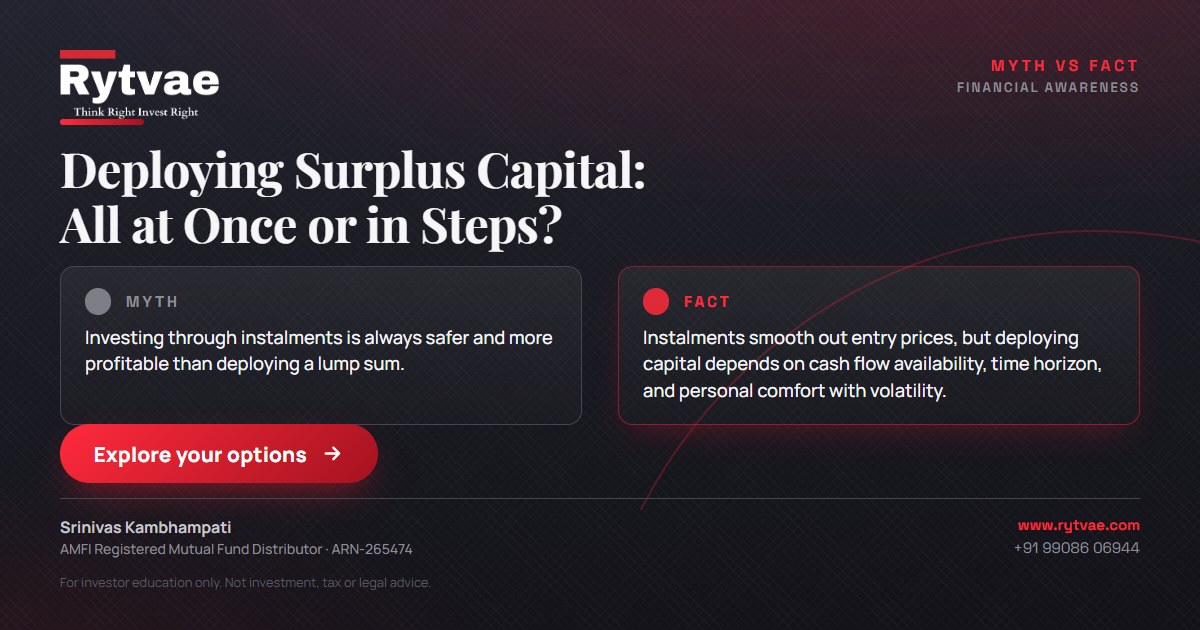
When an annual bonus arrives, an asset is sold, or business proceeds mature into cash, you face a common dilemma. You know the capital should not sit idle in a savings account earning modest interest, but the idea of committing the entire amount to market-linked instruments on a single day can feel unsettling.
Conversely, if you receive a predictable monthly salary or regular business drawings, waiting to accumulate a large amount before deploying it keeps your savings on the sidelines. Understanding how lump-sum investing and staggered instalments work helps you choose an approach suited to your cash flow and comfort with market swings.
The Mechanics of Lump-Sum Deployment
Lump-sum investing means deploying your entire available surplus into a fund at one time. In exchange, you receive units based on that specific business day's net asset value (NAV). From that day onward, your full capital participates in the underlying market movements, both upward and downward.
The primary advantage of this route is complete time in the market. In financial history, broad markets have tended to reflect underlying economic growth over extended holding periods. When you deploy funds immediately, the entire sum begins working towards your financial milestones without delay. However, this method exposes the full balance to immediate short-term volatility. If markets correct shortly after deployment, the value of the portfolio drops in nominal terms, which can cause significant emotional distress to an unprepared investor.
How Instalment Investing Works
Instalment investing involves dividing your capital into predefined chunks and deploying them at recurring intervals, such as weekly or monthly. In mutual funds, this is commonly done through a Systematic Investment Plan (SIP) funded from a bank account, or a Systematic Transfer Plan (STP), where capital rests in a liquid or overnight fund and moves gradually into target equity or hybrid funds.
The mathematical principle underlying this approach is rupee cost averaging. When market valuations decline, your fixed instalment amount purchases a higher number of mutual fund units. When markets advance, the same instalment buys fewer units. Over time, this smooths out your average purchase cost per unit. More importantly, it removes the pressure of attempting to pick an ideal entry point, instilling discipline without requiring you to predict short-term market directions. You can test different deployment horizons and contributions using online financial calculators to visualize how periodic contributions compound over time.
Comparing Both Approaches Side by Side
Neither method is universally superior in every market cycle. Each serves distinct cash flow realities and behavioural profiles. The table below outlines how they differ across key operational and psychological parameters.
| Feature | Lump-Sum Investing | Instalment Investing (SIP / STP) |
|---|---|---|
| Source of Capital | Windfalls, bonuses, property sales, or maturity proceeds | Monthly salary, steady cash flow, or a parked liquid pool |
| Market Timing Risk | Concentrated on a single entry date | Spread across multiple dates and market cycles |
| Rupee Cost Averaging | Not applicable; units bought at one NAV | Active; buys more units when prices fall and fewer when they rise |
| Psychological Impact | High anxiety if markets dip immediately | Lower emotional stress during market downturns |
| Cash Drag Risk | Zero cash drag; 100% deployed immediately | Capital waiting in savings or liquid funds yields lower potential gains |
Behavioural Comfort Versus Mathematical Efficiency
From a purely theoretical standpoint, if an asset class tends to appreciate over decades, deploying capital as early as possible provides the maximum time for growth. Under this mathematical lens, holding capital back in low-yielding cash instruments while waiting to deploy it—often called cash drag—can moderate long-term overall progress during strong bull phases.
However, real-world investing is not lived on a spreadsheet. Investor psychology plays a decisive role in long-term success. If an individual commits a large sum to an equity fund on Monday and witnesses a sharp market correction on Friday, panic often takes over. That emotional discomfort can lead an investor to redeem units at an inopportune moment, turning a temporary paper loss into an actual financial setback. For individuals who know that short-term dips will test their resolve, spreading deployment over 6 to 12 months provides peace of mind that far outweighs theoretical mathematical differences.
Aligning the Approach with Life Milestones
The choice between lump sum and instalments should also align directly with your time horizon and life stage. For long-term commitments such as retirement planning in Bangalore, regular instalments matching your monthly surplus create an automated, disciplined path toward corpus accumulation over twenty or thirty years.
When planning for intermediate goals, such as secondary schooling or college expenses, a blended approach often works best. You can explore structured child education planning in India to determine whether dedicated lumps of capital should be paired with recurring monthly additions. A practical strategy for a large windfall is to place the capital into a low-volatility debt or liquid fund, and establish a systematic transfer into diversified growth funds across a comfortable window. This approach balances participation with emotional stability, keeping the long-term plan intact.
Frequently asked questions
Can I switch from a lump-sum to an instalment approach?
Yes. If you hold a lump sum in your bank account, you can invest it into a liquid or overnight mutual fund and initiate a Systematic Transfer Plan (STP) to move a fixed amount periodically into an equity or hybrid fund.
Is lump-sum investing risky for first-time investors?
A lump-sum entry can feel overwhelming for beginners because any immediate market dip is visible across the entire portfolio value. Starting with instalments often helps first-time investors become comfortable with day-to-day market movements.
How long should an instalment schedule last for a lump sum?
There is no fixed statutory rule, but many individuals spread deployment over 6 to 12 months depending on their comfort level, the magnitude of the corpus, and prevailing market volatility.
Does rupee cost averaging eliminate investment risk?
No. Rupee cost averaging reduces the timing risk of buying at a single market peak, but it does not protect against overall market drops or guarantee positive returns.
Rytvae Consulting — AMFI Registered Mutual Fund Distributor (ARN-265474), EUIN E091320. This material is published for general investor education and awareness. It is not investment advice, tax advice or legal advice, and it does not take account of any individual's objectives or circumstances. Please consult an appropriately qualified professional before acting. Rytvae Consulting is not a SEBI-registered investment adviser.
See our full disclosures and disclaimers.