
Rytvae Consulting — AMFI Registered Mutual Fund Distributor (ARN-265474), EUIN E091320
Employee-Only vs Family-Inclusive Group Health Cover: Structuring Sustainable Corporate Healthcare
Choosing between employee-only and family-inclusive group health insurance involves balancing premium outlays against employee retention and family security. Here is how employers can assess the true impact on renewal pricing, claims, and workplace morale.
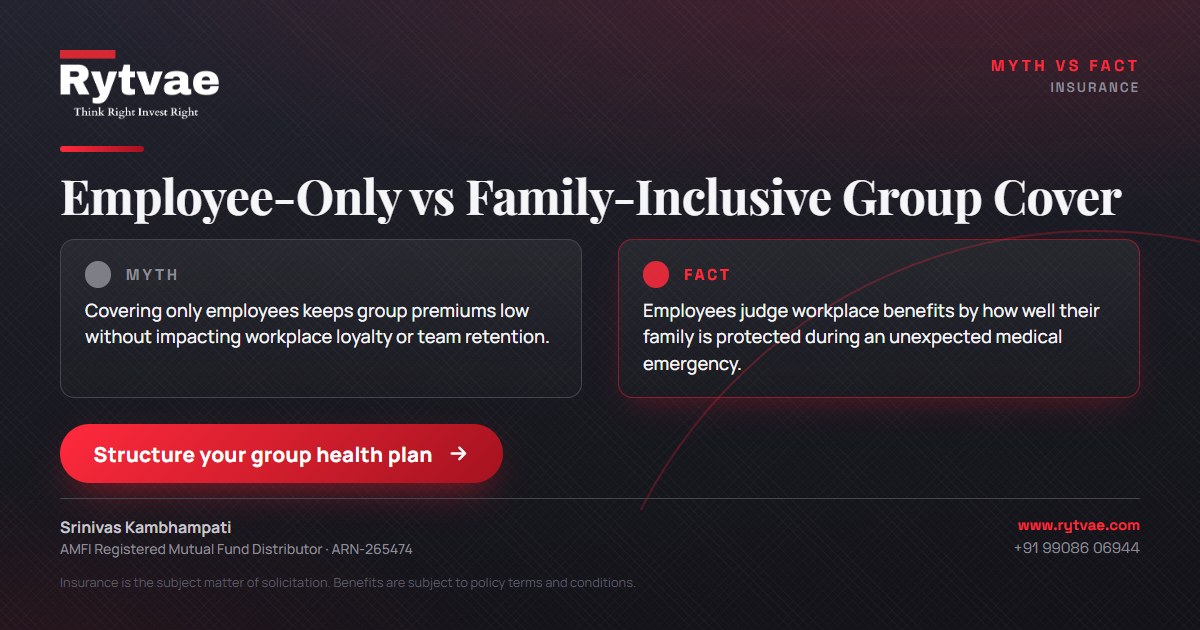
Setting up health protection for a growing team quickly brings founders and human resource leaders face-to-face with a fundamental design question. You must choose whether to restrict the sum insured strictly to the individual employee or extend coverage to spouses, children, and dependent parents.
An employee-only policy offers predictable, lower initial billing, yet an employee facing a spouse's emergency surgery or a child's hospitalisation still experiences severe personal and financial strain. Deciding which coverage model fits your enterprise requires looking past the immediate premium quote to examine claims patterns, administrative processes, and employee turnover.
The Core Differences in Coverage Scope and Structure
An employee-only group policy covers strictly the individual on the organisation's payroll. The sum insured applies exclusively to that single life, meaning claims arise solely from the employee's own hospitalisations, illnesses, or accidental injuries.
A family-inclusive policy operates as a floater structure covering defined relationships. Employers generally select from standard bandings such as employee plus spouse, employee plus spouse and up to two children, or broader configurations that incorporate dependent parents or parents-in-law. Under this floater mechanism, any covered family member can draw from the designated sum insured during the policy year.
When an organisation designs a corporate group insurance program, selecting the covered unit dictates not just the policy wording, but the operational complexity of additions, deletions, and claims management across the team.
How Dependant Inclusion Alters Claim Dynamics and Renewals
Group health insurance pricing is directly linked to the demographic profile of the covered group and its historical claims experience. The underlying mechanics shift substantially when dependants enter the policy pool.
A workforce comprised largely of young professionals tends to exhibit low hospitalisation frequency when covered alone. However, adding spouses and children introduces maternity claims, neonatal care, and frequent paediatric treatments. While these claims are manageable, adding elderly parents introduces a completely different risk profile, characterised by chronic condition management, joint replacements, and cardiac procedures.
Insurers price group covers based on the Incurred Claim Ratio, which measures claims paid against the net premium collected. When parent inclusion drives claims significantly above collected premiums, the insurer will adjust the subsequent renewal quote upward to restore underwriting balance. Understanding what actually drives group health insurance cost helps management anticipate these adjustments rather than facing sudden budget shocks at the annual renewal.
Comparing Employee-Only and Family-Inclusive Models
To evaluate which structure aligns with company budgets and human capital goals, consider how both formats compare across key operational and financial parameters.
| Evaluation Parameter | Employee-Only Coverage | Family-Inclusive Coverage |
|---|---|---|
| Upfront Premium Cost | Substantially lower, calculated across a uniform headcount base. | Higher per employee, scaling upward if parents are included. |
| Claims Volatility | Generally lower, reflecting the working-age demographic of the team. | Higher, reflecting varied age brackets and family health needs. |
| Talent Retention Impact | Perceived as basic compliance or entry-level benefit. | Viewed as meaningful personal security, aiding retention. |
| Administrative Overhead | Straightforward onboarding; requires only employee details. | Requires collecting marriage certificates, birth dates, and KYC for dependants. |
| Renewal Predictability | Relatively stable year-on-year loss ratios. | Requires active monitoring of claim ratios to prevent renewal hikes. |
Middle Paths: Co-Pay, Voluntary Top-Ups, and Tiered Covers
Choosing a structure does not have to be an all-or-nothing decision. Growing organisations frequently deploy hybrid frameworks that balance fiscal prudence with compassionate employee care.
One common structure involves the company funding a base floater for the employee, spouse, and children, while offering parental coverage as a voluntary, employee-funded add-on through corporate-negotiated rates. Because individual retail policies for senior citizens carry strict waiting periods and underwriting requirements, accessing a corporate plan—even when paid by the employee through salary deductions—provides immense value to team members.
Another viable approach introduces structural cost-containment measures, such as mandatory co-payment terms on specific treatments or parental claims, while keeping employee and paediatric hospitalisation fully covered. Reviewing structured options under group health insurance for employees allows business owners to protect staff without overcommitting the corporate treasury.
Personal Coverage as a Foundation for Employees
Employers should also communicate the limitations of corporate protection clearly to their workforce. While a family-inclusive corporate plan offers immediate peace of mind without individual medical underwriting, it remains contingent on continued employment with that specific firm.
During career transitions, sabbaticals, or unexpected corporate restructuring, group coverage terminates. Employees who rely solely on corporate floaters without holding independent family floater health insurance risk finding themselves uninsured when an illness occurs between jobs or later in life when retail underwriting becomes stringent. Encouraging team members to maintain an independent base retail cover alongside company benefits establishes genuine long-term resilience for their households.
Frequently asked questions
Can an employer change from an employee-only plan to a family floater mid-year?
Structural policy changes are generally executed at the time of annual policy renewal. Insurers require underwriting reviews to revise terms, demographic bands, and pricing structures across the active group.
Why does adding parents increase group health insurance premiums significantly?
Senior dependants experience higher hospitalisation frequency and higher average claim values due to age-related and chronic ailments. This elevated risk alters the policy's loss ratio, driving higher premium quotations from underwriters.
What happens to dependant coverage if an employee resigns?
Dependant cover under a group policy ceases on the employee's official date of separation from the company. Insurers allow portability to retail individual covers, subject to regulatory timelines and specific insurer underwriting terms.
Can employees pay the premium difference to add their parents to a corporate policy?
Yes, many insurers support voluntary parental add-on programs. The organisation negotiates the group terms and rates, while the employee pays the premium portion attributed to their parents via payroll deduction.
Rytvae Consulting — AMFI Registered Mutual Fund Distributor (ARN-265474), EUIN E091320. Insurance is the subject matter of solicitation. The benefits described are indicative and are governed entirely by the policy wording, terms, conditions and exclusions of the issuing insurer. Please read the policy document before concluding a sale. Rytvae Consulting acts as a distribution intermediary and does not underwrite risk or settle claims.
See our full disclosures and disclaimers.