
Home / Insights / Business finance
Rytvae Consulting — AMFI Registered Mutual Fund Distributor (ARN-265474), EUIN E091320
Secured vs Unsecured Business Loans: How to Structure Your Company's Borrowing
When an enterprise needs working capital or expansion funds, choosing between secured and unsecured debt determines repayment pressure, credit capacity, and asset exposure. Here is how both structures operate in practice.
Growing enterprises regularly face moments where operating cash flow cannot cover immediate commercial obligations. A distributor may need to warehouse inventory ahead of a seasonal peak, or a manufacturing firm might need to install additional processing equipment to fulfill a corporate tender. In these situations, turning to formal commercial credit is routine, but deciding how to borrow is rarely straightforward.
The dilemma usually settles on whether to pledge business or personal assets for a secured loan, or to pursue an unsecured credit facility based solely on financial track records. While avoiding asset pledges feels intuitive, the operational differences between secured and unsecured borrowing affect working capital stability and long-term servicing capacity in significant ways.
Defining the Fundamental Distinction: Security and Recourse
The foundational difference between these two credit models rests on how the lending institution manages default risk. In a secured business loan, the enterprise or its promoters pledge a tangible, marketable asset as collateral. This asset often takes the form of commercial office space, industrial land, a residential property, or specific plant and machinery. The lender places an equitable or registered charge on the title. If the firm cannot service the facility, the lender retains legal recourse to liquidate the pledged collateral to recover outstanding dues.
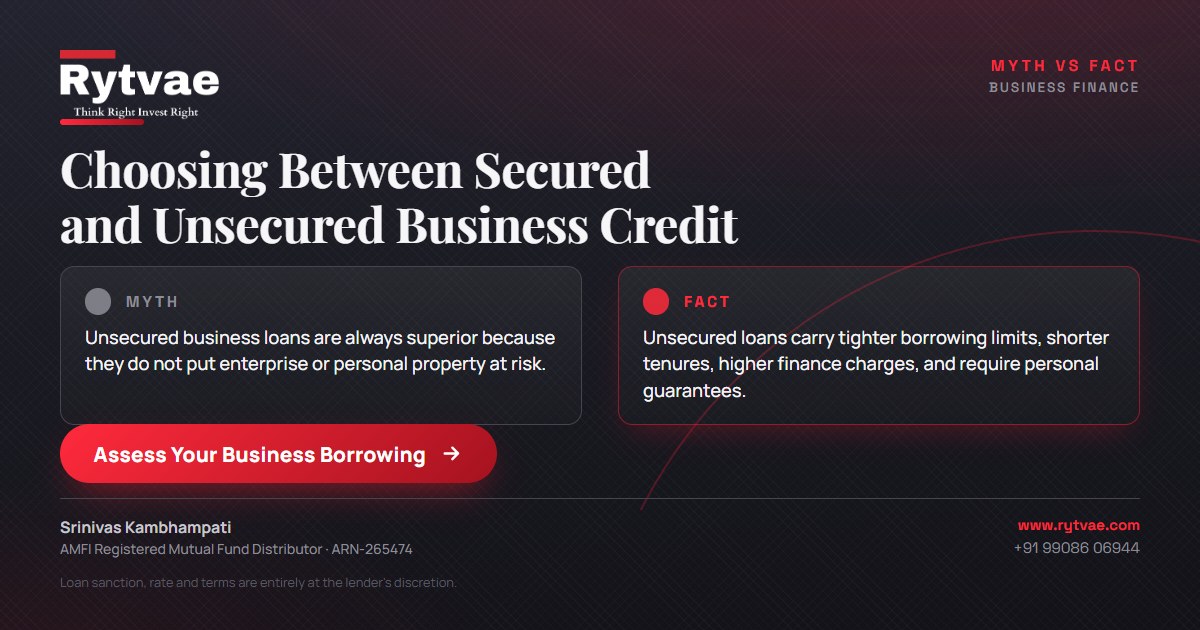
An unsecured business loan does not create an asset-backed charge. Instead, the lending decision hinges on past operating metrics: historical turnover, GST filings, balance sheet solvency, and documented banking conduct. Because the lender holds no specific physical claim to an underlying property, underwriting standards for cash flow consistency become stringent. Furthermore, lenders almost universally require personal guarantees from the managing partners or directors, which means operational default still creates direct personal recourse for the business leadership.
For owners exploring how different organizational forms influence credit criteria, reviewing business loan eligibility across business structures offers helpful clarity on documentation norms.
Borrowing Capacity and Tenure Realities
Collateral provides structural comfort to credit committees, directly impacting two vital loan terms: loan quantum and repayment tenure. When property is pledged, sanction limits are pegged to a proportion of the asset's assessed market value alongside cash-flow repayment capacity. This allows enterprises to access substantial funding amounts required for capacity expansion, large commercial acquisitions, or enterprise-scale consolidation.
Unsecured loans operate under tighter mathematical ceilings. Lenders generally cap the sanction as a multiple of average monthly bank credits, net profit margins, or annual gross revenue. As a result, unsecured debt is primarily suited for incremental operational needs rather than major capital expenditure.
Repayment tenures reflect a similar divergence. Secured facilities, such as term loans against property, provide extended amortisation horizons spanning multiple years. This spreads principal servicing over time and softens the monthly drain on operating cash. Conversely, unsecured commercial loans feature compact tenures, often requiring full clearance within a short window. While the debt is extinguished quickly, monthly cash outflow remains substantially heavier during that period.
Comparison: Secured versus Unsecured Business Borrowing
Evaluating both avenues side by side helps clarify how each structure aligns with enterprise finances:
| Operational Parameter | Secured Business Loan | Unsecured Business Loan |
|---|---|---|
| Primary Underwriting Basis | Asset valuation combined with operational debt-service coverage. | Operating cash flows, banking turnover, and historical profits. |
| Collateral Requirement | Tangible asset pledged via equitable mortgage or formal charge. | No physical asset pledged; relies on personal or corporate guarantees. |
| Available Loan Quantum | Typically higher, bounded by property valuation and servicing bandwidth. | Restricted, calculated as a fraction of monthly turnover or cash flow. |
| Repayment Horizon | Extended tenure, allowing gradual capital amortisation. | Short to medium tenure, resulting in higher monthly cash outflow. |
| Disbursement Timeline | Longer, due to legal searches, title clearance, and property valuation. | Faster, focusing primarily on banking verification and digital data. |
| Impact of Business Stress | Pledged collateral remains subject to recovery actions under applicable law. | Promoters remain liable through personal guarantees; severe credit rating damage. |
Cash Flow Implications and Speed of Disbursement
Selecting a borrowing structure solely on the desire to keep assets unencumbered can introduce unexpected balance sheet pressure. Because unsecured loans compress principal repayment into a brief schedule, the monthly installment absorbs a large share of gross margin. If seasonal sales slow down or debtor receivables stretch unexpectedly, high monthly obligations can strain working capital liquidity.
However, turnaround speed remains the distinct advantage of unsecured facilities. Legal due diligence, title verification, municipal searches, and physical valuation for secured assets take meaningful processing time. When an enterprise must seize a sudden supply discount, address an immediate vendor bottleneck, or bridge a brief receivable gap, the bureaucratic duration of a secured facility may cause the business to miss the window. Unsecured credit can be processed considerably faster because verification focuses on electronic bank statements and tax filings.
Business leaders assessing their credit parameters can utilize a structured credit risk assessment to measure debt-servicing strength before presenting files to institutions.
Aligning Credit Type with Commercial Purpose
Prudent financial management matches the duration and structure of debt to the economic life of the requirement. Using short-term, high-outflow unsecured credit to finance permanent assets—such as heavy machinery or long-term warehouse construction—creates an immediate asset-liability mismatch. The asset generates revenue over a decade, but the debt must be repaid over a very brief window, eroding operating buffers.
Conversely, undergoing months of title verification and paying extensive mortgage stamp duties for a brief, transient working-capital gap is inefficient. In many corporate roadmaps, firms utilize both structures concurrently: maintaining a secured facility for structural base financing and employing unsecured lines for agile operational maneuvers.
Entrepreneurs seeking to evaluate prospective borrowing limits and monthly commitments can use a systematic business loan eligibility assessment to review options. Those with unencumbered commercial or residential property may also study loan against property considerations to determine how formal security changes funding terms.
Frequently asked questions
What types of collateral can serve as security for a business loan?
Lenders commonly evaluate registered commercial premises, industrial sheds, residential real estate, or liquid financial instruments. Acceptability depends entirely on the institutional credit policy and clear, unencumbered legal titles.
Does an unsecured business loan require personal guarantees?
Yes. Even when physical property is not mortgaged, lenders almost universally require personal guarantees from primary promoters, partners, or directors. In case of commercial default, individuals remain personally accountable for settling the dues.
Can a newly formed enterprise access an unsecured business loan?
Unsecured credit decisions depend heavily on established operating records, audited books, and consistent banking turnover. Early-stage businesses with less than two or three years of active tax filings typically face stringent restrictions when seeking unsecured lines.
Rytvae Consulting — AMFI Registered Mutual Fund Distributor (ARN-265474), EUIN E091320. Loan sanction, interest rate, tenure, charges and terms are entirely at the discretion of the lender and subject to its credit policy and documentation requirements. Rytvae Consulting does not sanction credit, does not guarantee approval and does not represent any specific lender's terms. This material is for general education only.
See our full disclosures and disclaimers.