
Fertility-Treatment Health Cover in India: Understanding Exclusions, Sub-Limits, and Clauses
Fertility treatments involve multi-stage clinical procedures that standard retail health insurance policies in India generally exclude. Here is how to verify waiting periods, sub-limits, diagnostic coverage, and group policy terms before incurring out-of-pocket medical expenses.
Couples navigating the emotional and physical demands of fertility treatments often encounter an unexpected administrative hurdle: an outright rejection of their health insurance claim. While hospitalization for surgical interventions or acute illnesses is well understood, reproductive treatments occupy a very distinct category within Indian insurance policy wordings.
Because medical protocols such as in vitro fertilization (IVF), intrauterine insemination (IUI), and intracytoplasmic sperm injection (ICSI) involve planned, multi-stage clinical cycles, insurers view them differently from sudden medical emergencies. Assuming that a comprehensive base health policy will pay for these clinical cycles without explicit policy wording can lead to significant out-of-pocket expenditure.
The Standard Exclusion: Why Retail Policies Exclude Infertility
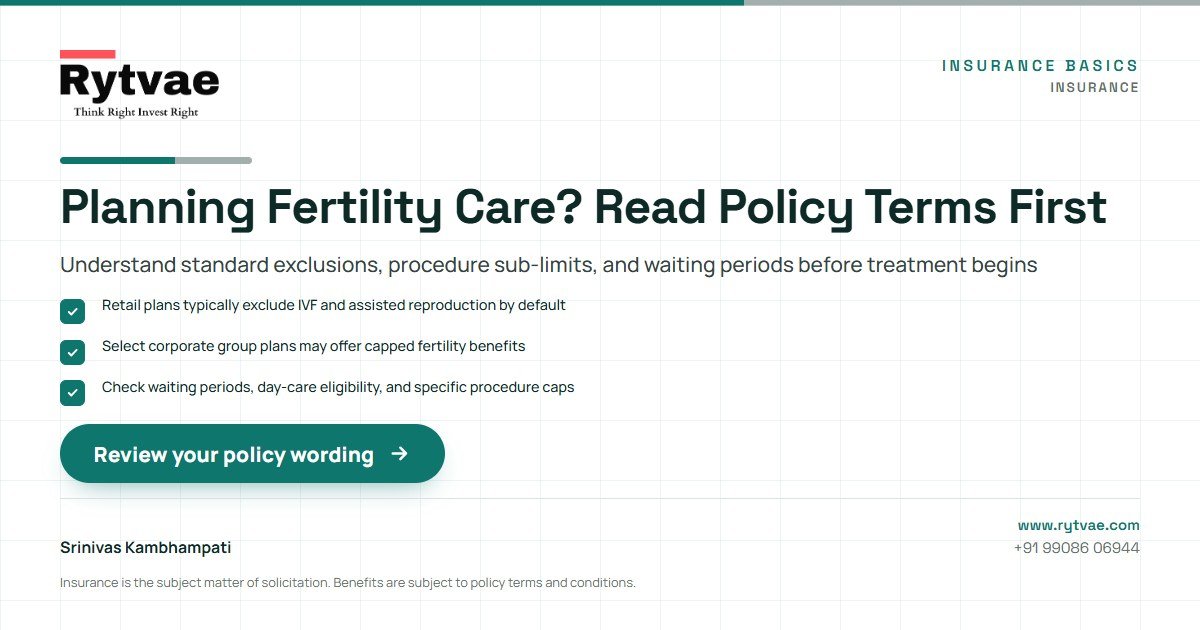
In standard retail health insurance policies, including conventional health insurance and family floater plans, infertility, sterility, and assisted reproductive technologies are typically listed under permanent or general exclusions. Standard wordings generally exclude any diagnosis or treatment related to assisted conception, hormone replacement therapies for reproductive purposes, and surrogate arrangements, unless an explicit endorsement is attached to the contract.
Insurers historically structured these exclusions because reproductive assistance involves elective, planned procedures with varying clinical success rates rather than fortuitous health events. Even when an insurer introduces a modern policy variant that covers fertility procedures, this cover is usually offered as an optional rider or as part of a specialised maternity package that carries distinct conditions, premium adjustments, and strict waiting periods.
Diagnostic Workups Versus Active Clinical Procedures
A frequent point of confusion for patients involves the difference between diagnostic investigations and active reproductive treatments. When you visit a specialist to investigate underlying pelvic pain, hormonal imbalances, or irregular cycles, the attending doctor may prescribe blood tests, ultrasounds, and diagnostic laparoscopies.
If a surgical procedure, such as a diagnostic laparoscopy, is performed to evaluate or treat a distinct pathological condition like endometriosis or ovarian cysts, standard inpatient hospitalization rules may apply, provided the admission meets the minimum duration or day-care requirements specified in your policy wording. However, the moment the clinical objective transitions from treating a pathological condition to initiating assisted reproduction cycles (such as egg retrieval, embryo transfer, or donor procedures), the insurer's exclusion clause typically takes effect.
It is essential to ask your treating hospital for itemized estimates and clinical summaries so that you know which diagnostic tests might be considered under routine medical conditions and which steps belong strictly to an excluded assisted reproduction protocol.
Corporate Group Covers and Specialised Riders
Unlike standard individual policies, employer-sponsored group health insurance policies frequently offer negotiated coverage terms. Progressive organisations often include fertility benefits as part of their comprehensive employee welfare programmes. When evaluating group health insurance for employees, human resource managers can negotiate the inclusion of infertility treatment riders.
However, even within employer-backed programmes, coverage is rarely open-ended. Human resource departments usually negotiate these benefits with explicit structural limits, such as a defined monetary cap per employee, limits on the number of covered cycles, or restricted eligibility based on employee band or marital status. When reviewing coverage details, it is wise to consult the company benefit guide alongside guidelines on employee eligibility in group health policies to confirm whether dependents are entitled to claim and what documentation is required.
Comparison of Fertility Benefits Across Policy Types
The table below summarizes how fertility-related expenses are typically addressed across standard retail policies versus structured corporate group health covers, unless specific policy terms state otherwise.
| Policy Feature | Standard Retail Health Policy | Corporate Group Cover (with Fertility Rider) |
|---|---|---|
| Assisted Reproduction (IVF/IUI/ICSI) | Typically excluded under general policy exclusions | Usually covered up to a negotiated sub-limit |
| Waiting Period | Usually 24 to 48 months if covered by an add-on rider | Frequently waived or limited to 9 to 12 months |
| Diagnostic Investigations | Covered only if tied to an admissible inpatient illness | Often covered under OPD or day-care allowances |
| Procedure Sub-Limits | Strict monetary cap or percentage of base sum insured | Fixed corporate sub-limit (e.g., set rupee ceiling per cycle) |
| Donor and Surrogacy Costs | Almost universally excluded | Generally excluded unless explicitly specified in terms |
Key Policy Parameters to Verify Before Treatment
Before undertaking an assisted reproduction cycle, policyholders should review the policy document or certificate of insurance to verify five primary parameters:
- Specific Definitions: Check whether the wording defines "assisted reproduction" broadly or lists individual procedures such as IVF, ICSI, and gamete intrafallopian transfer. If a procedure is not explicitly included in the covered list, it is generally treated as excluded.
- Waiting Periods: If your policy includes fertility coverage through a maternity add-on, confirm the exact waiting period. Waiting periods typically range from two to four consecutive policy years before benefits become operational.
- Day-Care Procedure Inclusion: Many stages of assisted reproduction do not require a 24-hour hospital stay. Verify whether the policy covers day-care procedures for reproductive care, or if it requires full inpatient admission.
- Sub-Limits and Lifetime Maximums: Fertility benefits almost always feature an aggregate financial sub-limit. This limit is often independent of your base hospitalization sum insured and may apply per policy year or as a cumulative lifetime ceiling.
- OPD Pharmacy and Hormonal Medication: A considerable portion of fertility expenditure involves injectable hormones and oral medications administered outside the hospital. Determine whether your policy includes outpatient (OPD) prescription benefits or restricts reimbursement strictly to medications administered during an admitted procedure.
For individuals paying health insurance premiums for themselves and eligible family members, premiums may qualify for a Section 80D deduction under the old tax regime only, provided all regulatory and payment mode requirements are satisfied. However, tax deductibility of the premium does not alter the underlying claim admissibility of specific medical procedures.
Taking the time to read the exact policy exclusions, schedule of benefits, and rider conditions allows families to budget their medical expenses with clarity and avoid stressful claim disputes during an already demanding phase of life.
Frequently asked questions
Does standard health insurance in India cover IVF or IUI procedures?
In standard retail health policies, IVF and IUI are typically excluded under general infertility exclusions. A few comprehensive policies or optional maternity riders offer limited coverage, but only after specified waiting periods and subject to strict sub-limits.
Why do corporate group policies often cover fertility when personal policies do not?
Corporate employers can customize group health policies with insurers by paying an additional premium to include tailored maternity and fertility benefits. These group covers also frequently waive or reduce the multi-year waiting periods found in individual policies.
Are the costs of fertility medications and diagnostic tests reimbursable?
Diagnostic tests and outpatient hormonal injections are generally not covered under basic hospitalization policies unless your plan includes an active outpatient department (OPD) rider or corporate day-care benefit that explicitly covers reproductive care.
Does paying premiums for a policy with fertility riders affect tax benefits?
Health insurance premiums paid for eligible family members can qualify for a Section 80D deduction under the old tax regime only. However, tax benefits apply to the premium paid, not to whether a specific fertility claim is approved or rejected by the insurer.
Insurance is the subject matter of solicitation. The benefits described are indicative and are governed entirely by the policy wording, terms, conditions and exclusions of the issuing insurer. Please read the policy document before concluding a sale. Srinivas Kambhampati, IRDAI-certified POSP, SSID-134076, attached to PolicyBoss, working under the brand Rytvae Consulting, does not underwrite risk or settle claims.
See our full disclosures and disclaimers.