
Including Parents in an Employer Group Health Scheme: Benefits, Risks, and Key Trade-offs
Adding parents to an employer group health scheme provides immediate cover for pre-existing conditions, but relying entirely on office insurance carries significant long-term risks. Here is how to evaluate the benefits, policy caps, and transition hazards.
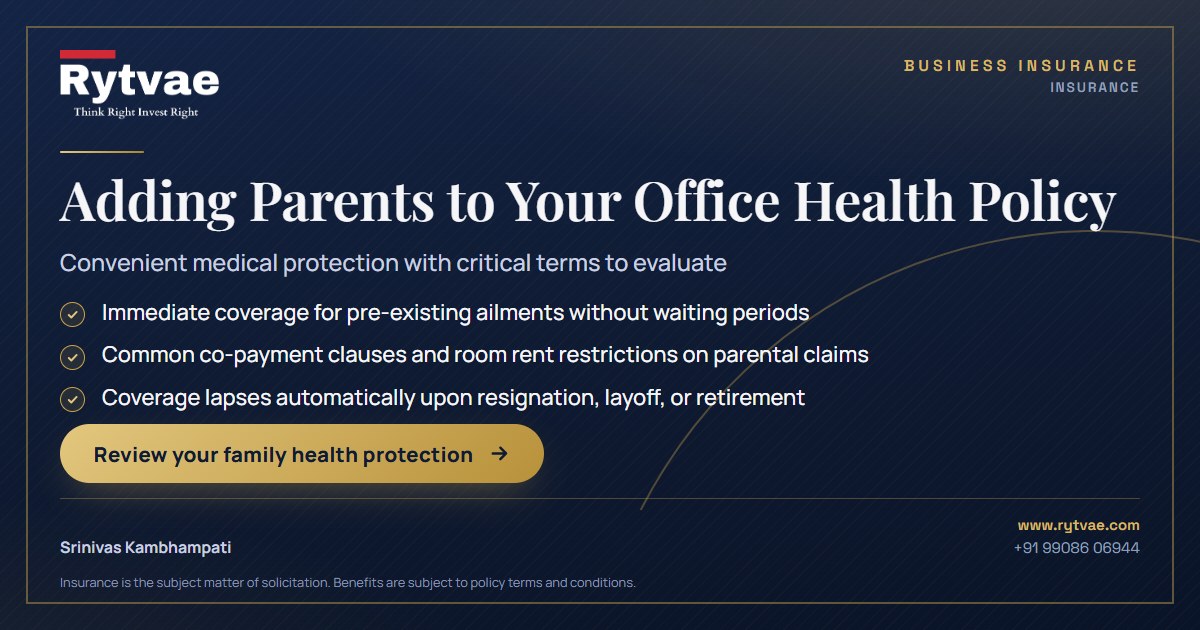
Every year during corporate benefits renewal, salaried professionals face a critical decision on whether to enroll their dependent parents in the company's medical policy. With private hospital bills rising steadily across Indian metros, the thought of securing healthcare protection for aging parents through a simple payroll deduction feels reassuring and convenient.
However, treating an employer group plan as your parents' primary medical safety net can lead to unexpected out-of-pocket expenses or sudden coverage gaps. While corporate schemes offer unmatched entry terms for older individuals, they also operate under strict commercial constraints that every family must understand before making a choice.
The Immediate Advantage: Day-One Protection
The single greatest strength of including parents in group health insurance for employees is the waiver of standard retail waiting periods. In the individual health insurance market, senior citizens often face rigorous medical tests, policy loadings, and mandatory waiting periods of two to four years before the insurer covers pre-existing illnesses like hypertension, diabetes, or joint conditions.
Under an employer's group policy, insurers typically negotiate a waiver for pre-existing conditions. Your parents gain hospitalisation cover from the very first day their enrollment becomes active. For an elderly parent who has already suffered a cardiac episode or undergone surgery, obtaining a comprehensive retail policy may be difficult or prohibitive. In such circumstances, the employer's policy provides immediate access to private healthcare networks that would otherwise be unavailable.
Furthermore, enrollment in a corporate scheme usually bypasses the stringent pre-policy medical checkups required for individual senior citizen plans. As long as your organisation's employee eligibility rules accommodate dependent parents, inclusion is generally guaranteed during the annual renewal window or upon joining the firm.
Understanding the Operational Constraints: Sub-Limits and Co-Pays
While access is easy, the depth of coverage under parental group add-ons is often heavily restricted. Insurers manage the higher claim probability of senior citizens by incorporating structural cost-containment clauses into the group policy wording.
The most common restriction is a mandatory co-payment clause on parental claims, often requiring the employee to bear 10% to 20% of the approved bill. On a major hospitalisation bill of several lakh rupees, this copay represents a significant cash outlay. Additionally, corporate policies frequently introduce proportionate deductions tied to room rent limits, capping daily room charges to a fixed amount or a low percentage of the sum insured. Opting for a hospital room above this cap triggers proportionate deductions across the entire bill, including doctor fees and procedural charges.
Disease-wise sub-limits are also standard in parental group covers. High-frequency procedures such as cataract surgeries, joint replacements, and cardiac interventions frequently carry internal maximum payout caps regardless of your overall sum insured.
Floater Dilution vs. Separate Parental Sum Insured
Corporate health structures generally adopt one of two designs for parental inclusion: a shared floater or a dedicated parental sum insured. Understanding which structure your employer uses is essential to avoiding family-wide underinsurance.
In a shared floater, your spouse, children, and parents all draw from the same overall balance. If an elderly parent experiences a prolonged ICU stay early in the policy year, that single claim can wipe out the entire sum insured, leaving your spouse and children without protection for the remaining months. This dynamic is why structuring a family floater health insurance policy across three generations in a single bucket requires extreme caution.
Whenever your company's benefits portal allows it, opt for a separate sum insured dedicated exclusively to parents, even if it requires a higher voluntary employee contribution. Isolating the parental risk pool preserves the financial cushion allocated for your immediate household.
Comparison: Corporate Parental Add-on vs. Independent Retail Policy
To see how these two coverage routes complement each other, consider their core operational differences:
| Feature | Employer Group Health Scheme | Independent Retail Health Policy |
|---|---|---|
| Waiting Periods | Typically waived from day one for pre-existing conditions. | Standard waiting periods apply before specific illnesses are covered. |
| Medical Underwriting | No medical screening required during normal enrollment. | Detailed underwriting and medical tests based on age and history. |
| Policy Continuity | Ends when you resign, face redundancy, or retire. | Guaranteed renewable for life as long as premiums are paid on time. |
| Sub-limits and Co-pays | Frequently applied to senior dependents to control claims. | Varies; zero co-pay and no room rent sub-limit plans are available. |
| Control Over Terms | Employer can alter benefits or drop parental cover annually. | Terms are governed by individual contracts and regulatory rules. |
The Continuity Trap: Job Transitions and Retirement
The most critical hazard of relying solely on an employer's group policy is the lack of tenure security. Corporate group health insurance is tied to your active employment. If you switch jobs, face corporate restructuring, or retire, your parents' coverage ceases on your last working day.
While regulatory provisions allow employees to port their group coverage into an individual retail plan with the same insurer, the reality of retail porting is nuanced. The retail insurer retains the right to underwrite the incoming individual policy based on current health status. If your parents have developed chronic conditions during your tenure with the employer, the insurer may impose substantial premium loadings, introduce permanent exclusions, or decline the application altogether.
Attempting to purchase a fresh individual health policy for parents in their late sixties or seventies is significantly harder and costlier than securing that same policy when they are in their fifties. Relying entirely on an office policy during their healthiest years creates an acute vulnerability later in life.
Designing a Resilient Dual-Layer Protection Plan
Rather than viewing corporate insurance and personal insurance as mutually exclusive, families managing a health cover for a multigenerational household should treat them as complementary layers.
Use the employer's group cover as the first line of defence. Because it covers pre-existing illnesses without waiting periods, it can absorb ongoing treatments, planned minor surgeries, and claims subject to co-pays. Alongside this, maintain a standalone retail health policy or an individual base policy paired with a high-deductible super top-up plan for your parents. Starting an independent policy early allows the statutory waiting periods to run their course while the parents are relatively healthy, locking in lifetime renewability.
This dual approach ensures that unexpected job movements never leave your aging parents exposed to private hospital costs, while allowing your household to leverage the immediate subsidies and convenience of corporate benefits.
Frequently asked questions
Does corporate health insurance cover parents' pre-existing conditions immediately?
Yes, group policies generally waive waiting periods for pre-existing conditions from day one, subject to the terms negotiated by your employer. In contrast, retail plans typically require a waiting period of several years before covering such conditions.
What happens to my parents' coverage if I change employers or retire?
Coverage under an employer group health scheme ceases once your employment terminates. While porting to an individual retail plan is possible under insurance regulations, the insurer reviews the medical history and underwrites the policy afresh, which can lead to higher premiums or exclusions.
Should I choose a separate sum insured for parents or share a single floater?
Opting for a separate sum insured for parents is generally safer if your employer's plan allows it. Sharing a single floater means a single major hospitalisation for an elderly parent could consume the entire sum insured, leaving your spouse and children unprotected for the rest of the year.
Why do corporate policies impose co-pays specifically on parental claims?
Insurers apply co-payment clauses to parental claims to manage the higher claim frequency and treatment costs associated with older age groups. Requiring the employee to fund 10% to 20% of the claim keeps group premium costs viable for employers.
Insurance is the subject matter of solicitation. The benefits described are indicative and are governed entirely by the policy wording, terms, conditions and exclusions of the issuing insurer. Please read the policy document before concluding a sale. Srinivas Kambhampati, IRDAI-certified POSP, SSID-134076, attached to PolicyBoss, working under the brand Rytvae Consulting, does not underwrite risk or settle claims.
See our full disclosures and disclaimers.