
Home / Insights / Mutual Funds
Srinivas Kambhampati — AMFI Registered Mutual Fund Distributor (ARN-265474), EUIN E091320
Why SIPs Do Not Eliminate Investment Risk in Mutual Funds
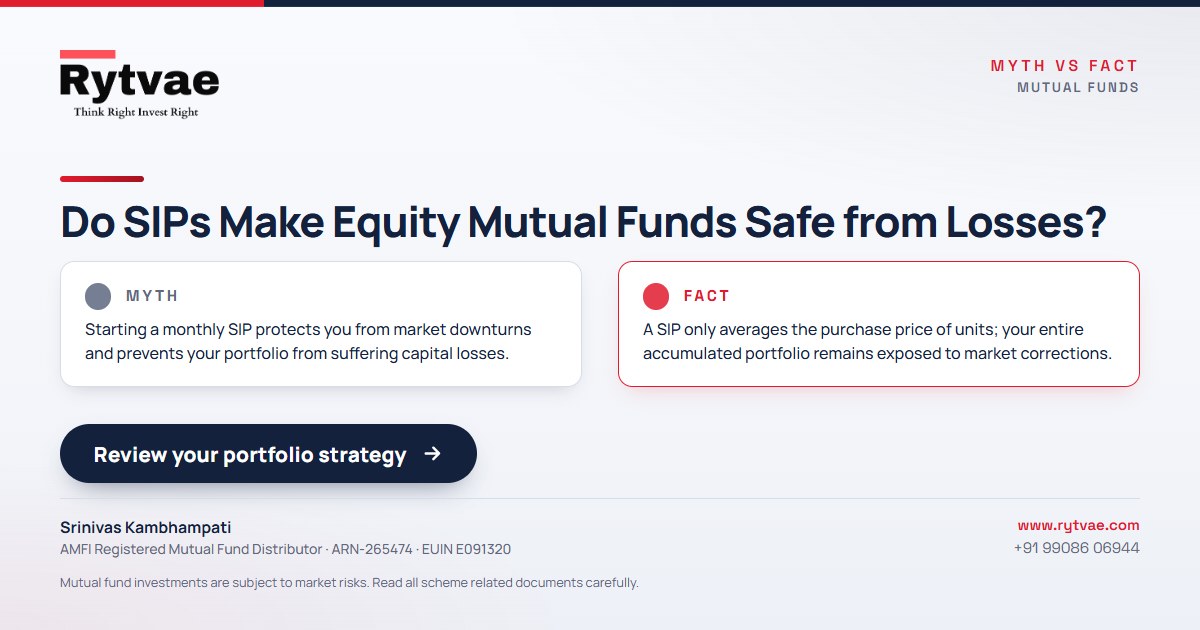
Many investors believe that choosing an SIP protects them from market volatility. While regular investing builds discipline and averages purchase prices, it cannot shield your accumulated wealth from market declines.
You set up an automated debit from your bank account every month, confident that systematic investing will protect you from market volatility. Then a broad market correction occurs, and you open your portfolio statement only to find the value of your accumulated units lower than the total amount you transferred. The feeling of disappointment is common, driven by a widespread belief that a Systematic Investment Plan makes equity investments risk-free.
To invest with confidence, you must separate the method of purchasing units from the asset class you own. A SIP is simply a payment schedule; it is not a protective shield against economic shifts, business earnings cycles, or market downturns.
The Confusion Between the Mechanism and the Underlying Asset
A frequent error among retail investors is treating an SIP as if it were a distinct asset class, similar to a fixed deposit or a public provident fund. In reality, an SIP is merely a transfer instruction. It tells your bank to transfer a fixed sum on a specific date to purchase units of a chosen mutual fund scheme.
When you start SIP investment plans in an equity mutual fund, every rupee buys units in a fund that invests in company shares. If equity markets decline, the Net Asset Value (NAV) of the scheme declines as well. The systematic nature of your purchase does not insulate the underlying businesses from macroeconomic headwinds, changing regulatory environments, or valuation corrections. Your holdings remain equity securities, carrying the full spectrum of market volatility.
What Rupee Cost Averaging Achieves and Where It Stops
The primary mathematical advantage of an SIP is rupee cost averaging. When the market falls, your fixed monthly instalment purchases more units at a lower NAV. When the market rises, the same amount buys fewer units at a higher NAV. Over several market cycles, this process lowers your average cost per unit compared to purchasing all your units at a single market peak.
However, lowering your average acquisition price is fundamentally different from removing risk. Rupee cost averaging addresses a single hazard: the timing risk of deploying a lump sum right before a steep market drop. It cannot prevent periods of negative portfolio value. If an index experiences a prolonged bear phase, the NAV can remain below your average purchase price for extended intervals, resulting in temporary capital erosion.
| Aspect | What an SIP Does | What an SIP Cannot Do |
|---|---|---|
| Market Timing | Removes the urge to predict market tops and bottoms | Make sure you always buy at the absolute bottom |
| Cost of Acquisition | Averages out purchase prices across different market phases | Prevents the NAV from falling below your average cost |
| Accumulated Corpus | Enforces monthly savings discipline from your cash flow | Protects past accumulated wealth from broad market crashes |
| Asset Class Volatility | Allows gradual exposure to equity market swings | Transforms equity risk into a fixed or capital-protected return |
The Maturing Corpus Problem: Why SIPs Protect Less Over Time
One critical mechanism that many investors overlook is the diminishing impact of rupee cost averaging as an investment matures. In the early stages of a monthly SIP, each new instalment forms a significant percentage of your total mutual fund holdings. If you have invested ₹10,000 for three months, a fourth instalment of ₹10,000 represents 25 percent of your total invested capital. The cost averaging effect in these initial months is potent.
Fast forward eight or ten years. Your accumulated corpus may stand at several lakh rupees. If the market experiences a sharp correction of 20 percent, your portfolio loses value on the entire accumulated balance. A fresh monthly instalment of ₹10,000 represents a negligible fraction of your overall portfolio. It cannot meaningfully alter the average cost of the vast majority of units you already hold.
As your account balance grows, your portfolio responds to market volatility in almost the same manner as a lump sum investment. Assuming that an ongoing SIP will neutralise a market crash late in your investment horizon is an expensive misunderstanding.
Managing Portfolio Risk Through Asset Allocation
Because an SIP cannot eliminate investment risk on its own, true risk mitigation must come from portfolio construction. This begins with goal-based investing, where each financial objective is mapped to an appropriate timeline and risk tolerance rather than selecting funds based on recent performance charts.
For goals that are many years away, equity SIPs provide an effective vehicle for accumulating assets, provided you can accept paper drawdowns along the way. But as the target date of your goal approaches, relying solely on an SIP is inadequate. Investors must systematically reduce equity exposure and move accumulated capital into lower-volatility instruments to protect the corpus from an untimely market fall.
Engaging in periodic portfolio review and rebalancing ensures that your asset mix between equities, debt, and cash remains aligned with your personal risk tolerance. An SIP instils excellent habit and operational simplicity, but sound portfolio design remains the true foundation of capital management.
Frequently asked questions
Can my SIP show negative returns over a one or two year period?
Yes. Equity mutual funds track the underlying stock markets. If the market goes through a persistent downward trend, the fund Net Asset Value can fall below your average purchase cost, resulting in temporary negative returns on your statement.
Will running an SIP for five or ten years always give a profit?
No. SIP returns are not fixed. They depend on how the market performs, and SIPs do not remove market risk. While longer holding periods historically smooth out short-term market noise in equities, returns depend on the actual performance of the underlying portfolio companies and prevailing market conditions when you redeem.
Why does an SIP feel less effective at averaging costs after several years?
In the early months, each new instalment represents a large share of your total holdings. After several years, your accumulated corpus is much larger than any single monthly contribution, meaning a fresh instalment has minimal influence on your overall average acquisition cost.
How should an investor protect money in an ongoing SIP as a goal nears?
As you get closer to the date you need the funds, you should systematically shift accumulated capital from volatile equity schemes to lower-risk debt funds or liquid assets, rather than leaving the entire sum exposed to market swings.
Srinivas Kambhampati — AMFI Registered Mutual Fund Distributor (ARN-265474), EUIN E091320. Mutual fund investments are subject to market risks. Read all scheme related documents carefully. Past performance is not indicative of future returns. Srinivas Kambhampati is an AMFI Registered Mutual Fund Distributor (ARN-265474, EUIN E091320) and does not provide investment advisory services. This material is for investor education only and is not a recommendation to buy, sell or hold any scheme.
See our full disclosures and disclaimers.