
Home / Insights / Loans & credit
Rytvae Consulting — AMFI Registered Mutual Fund Distributor (ARN-265474), EUIN E091320
Matching Business Loan Tenure to the Purpose of Borrowing
Borrowing short-term funds for long-term assets can trigger an unexpected liquidity squeeze, while funding temporary working capital with multi-year loans accumulates needless interest. Here is how to align debt tenure with your actual business cycle.
When commercial cash flow tightens, business owners often accept whichever credit facility comes with the fastest approval or the lowest processing friction. A firm might draw down on an emergency one-year working capital line to buy an industrial packaging machine, or secure a five-year term loan simply to settle vendor dues during a seasonal dip.
While both transactions solve an immediate cash deficit, they introduce a structural hazard into your balance sheet. The problem is not merely the interest rate or the processing fee; it is the fundamental timing mismatch between how quickly the borrowed money must be repaid and how quickly the funded activity generates cash.
The Core Principle: Asset-Liability Matching
In corporate finance, the golden rule of credit structuring is asset-liability matching. Every rupee borrowed enters your business to support a specific asset or operational need. That asset has a distinct economic life, which is the period over which it produces revenue or liquidates back into cash.
If you finance an asset with a liability that matures far earlier than the asset can pay for itself, your operating cash flow must divert funds from regular operations to service the debt. Conversely, if you use long-term debt to fund an asset that converts back into cash within sixty days, you risk carrying expensive, idle debt service obligations long after the operational cycle has closed.
Short-Term Borrowing: Aligning with the Operating Cash Cycle
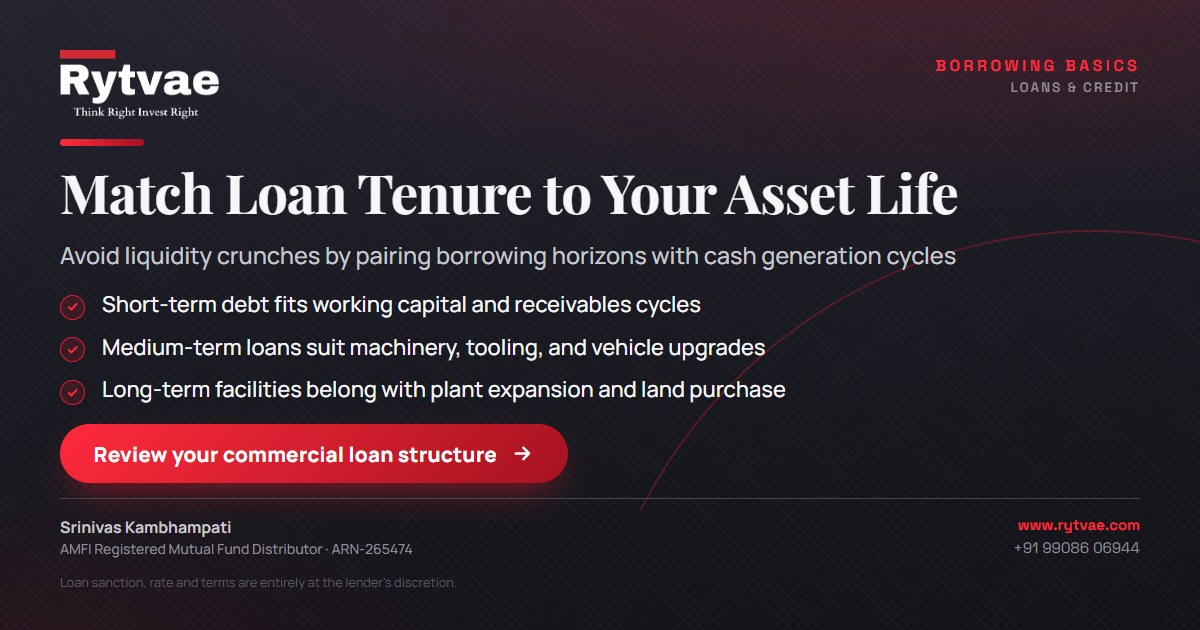
Short-term credit generally spans maturities from thirty days up to twelve months. This tier of commercial borrowing belongs strictly to the operational cycle of your business: purchasing raw materials, manufacturing inventory, delivering goods, and waiting for customer receivables to clear.
Because receivables and inventory turn over multiple times a year, the debt used to finance them should self-liquidate as clients settle their invoices. Facilities such as overdrafts, cash credit limits, and bill discounting are engineered precisely for this rhythm. Business owners evaluating whether their receivables cycle is healthy enough to support revolving lines often utilize a structured Business Loan Eligibility & Credit Analyzer to evaluate where their liquidity benchmarks stand.
When cash inflows are tied to specific buyer invoices rather than continuous turnover, dedicated solutions become relevant. Evaluating CC/OD or invoice discounting allows enterprises to see whether revolving credit or transactional financing better mirrors their billing calendar, preventing unutilized credit charges while maintaining sufficient working capital.
Medium- and Long-Term Facilities: Matching Asset Productivity
Medium-term loans (typically two to five years) and long-term loans (extending beyond five years) exist to finance capital expenditure. These include industrial machinery, testing equipment, office build-outs, logistics vehicles, and factory expansions.
Capital equipment does not generate a lump sum of cash in sixty days. Instead, it yields incremental output, modest efficiency gains, or expanded gross margins month after month over many years. A machine expected to operate productively for seven years should logically be funded with debt amortized over five to seven years.
This structure allows the machine's monthly production revenue to cover its own principal and interest repayments. For enterprises undertaking larger structural enhancements, such as commercial property construction or warehousing developments, lenders require distinct phase-driven facilities, often tied to a formal credit risk assessment to verify that cash generation horizons align with debt repayment terms.
The Dual Hazards of Debt Maturity Mismatches
Structuring commercial credit without aligning tenure creates two distinct financial traps, both of which erode enterprise value and lender relationships.
| Mismatch Scenario | Underlying Error | Financial Consequence |
|---|---|---|
| Short-Term Debt for Long-Term Assets | Using 6-to-12-month funds to purchase multi-year machinery or property. | Severe cash flow strain; heavy monthly repayments due before the asset generates adequate revenue, often forcing emergency refinancing. |
| Long-Term Debt for Short-Term Needs | Using a 5-year term loan to bridge a 60-day customer payment delay. | Compounded interest cost; the business pays financing charges for years on inventory or receivables that were liquidated months ago. |
The first scenario—funding long-term assets with short-term borrowing—is the most common cause of technical default among growing enterprises. When a one-year loan comes due, the equipment it purchased may have only generated a fraction of its total projected lifetime income. The enterprise must then scramble to roll over the loan, rely on high-cost merchant advances, or pull cash directly from daily operations.
The second scenario is subtler but steadily destructive. When seasonal operational deficits are folded into long-term term debt, the enterprise ends up servicing liabilities for inventory cycles that ended years earlier. Over time, the cumulative interest drag diminishes the operating margins of future contracts.
A Methodical Approach to Choosing Loan Tenure
Before applying for commercial credit, clarify the operational reality of the expenditure rather than looking solely at current interest rates or tenure caps offered by lenders:
- Calculate the cash conversion cycle: Determine the exact number of days it takes for raw material purchases to convert into realized bank receipts. If this cycle is ninety days, your financing mechanism should settle within that ninety-day window.
- Establish the payback window of capital assets: For equipment or infrastructure, review conservative revenue projections. Set the tenure so that projected net monthly inflows comfortably exceed the monthly debt service obligations.
- Factor in operational ramp-up periods: New production facilities rarely operate at peak capacity on day one. Ensure that loan structures accommodate realistic commissioning and stabilization phases without early cash depletion.
- Isolate one-off market disruptions: If a cash squeeze is caused by a single delayed government or enterprise invoice, seek transaction-level financing rather than absorbing an ongoing structural debt burden.
Commercial debt functions as an accelerator when matched to business needs, but acts as an operational anchor when mismatched. Aligning the maturity of your debt to the cash profile of the underlying asset protects working liquidity and keeps your balance sheet resilient.
Frequently asked questions
What is the primary danger of using short-term loans for capital purchases?
Capital purchases such as machinery take several years to pay for themselves through operational cash flow. A short-term loan requires complete repayment in months, forcing the business to service heavy principal payments out of regular working cash before the equipment can generate adequate returns.
Why is taking a long-term loan for working capital problematic?
Working capital items such as raw materials and inventory liquidate into cash within a single operating cycle. Repaying that cost over three to five years means the business pays continuous interest on goods that have long since been sold and consumed, eroding future profit margins.
How does an enterprise determine the right tenure for a business loan?
The tenure should mirror the cash realization cycle of the funded purpose. For operational supplies and customer receivables, choose revolving facilities that clear within weeks or months. For fixed assets, align the repayment horizon with the asset's projected breakeven and cash-generation schedule.
Rytvae Consulting — AMFI Registered Mutual Fund Distributor (ARN-265474), EUIN E091320. Loan sanction, interest rate, tenure, charges and terms are entirely at the discretion of the lender and subject to its credit policy and documentation requirements. Rytvae Consulting does not sanction credit, does not guarantee approval and does not represent any specific lender's terms. This material is for general education only.
See our full disclosures and disclaimers.