
SIP investment plans in Bangalore
A systematic investment plan is the least dramatic and most reliable way to build wealth in India. It is also the easiest thing to set up badly. This page covers how much to start with, what a step-up does, when a lumpsum is genuinely better, and how SIPs are taxed.
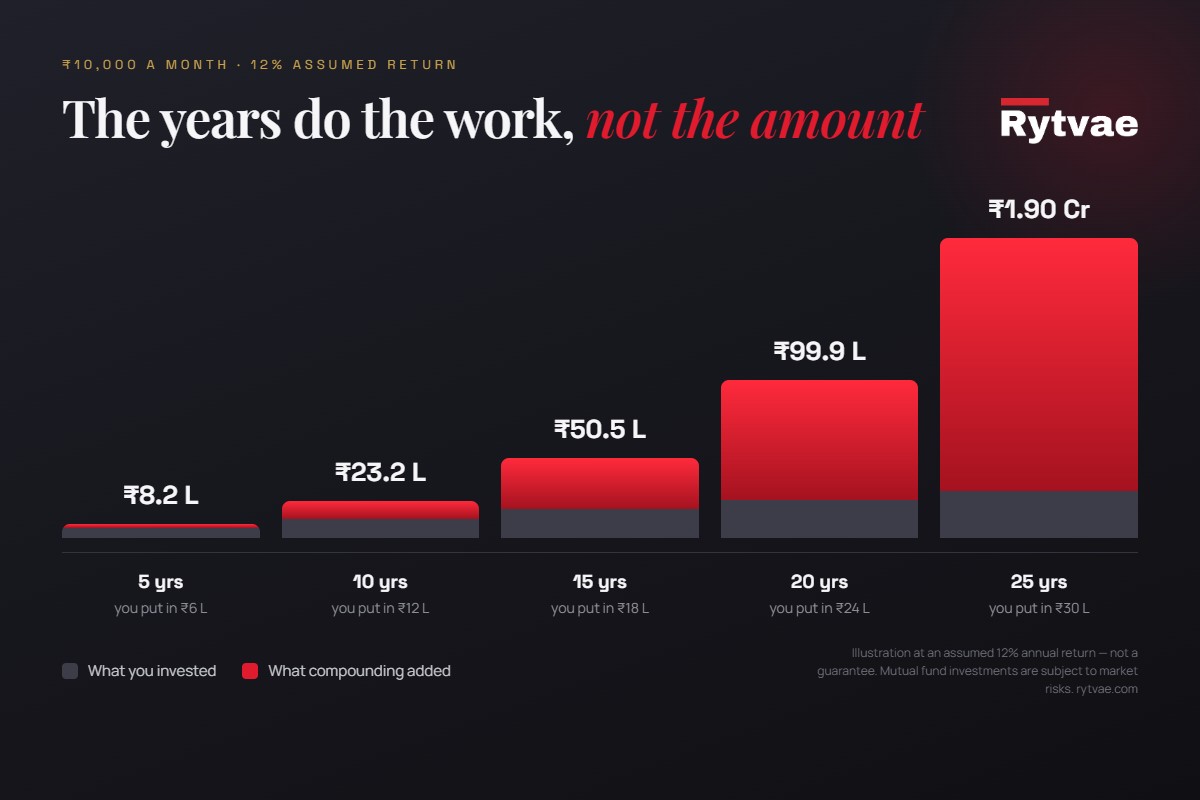
How much to start with
Most schemes accept an SIP from ₹500 a month; a few from ₹100. That is deliberately low, and the low bar is the point: the starting amount matters far less than the starting date.
A ₹5,000 SIP begun today will usually finish ahead of a ₹10,000 SIP begun in five years’ time, because the first one has five additional years for compounding to do the work. Waiting until you can “afford to invest properly” is the single most expensive habit in personal finance.
SIP or lumpsum
If the money is already sitting in your bank account, the mathematics favours investing it at once. Markets rise more often than they fall, so on average the sooner it is in, the better it does.
Behaviour usually favours the SIP. A lumpsum deployed a week before a 15% correction is exactly the experience that makes someone swear off equity for a decade — and the cost of that decade dwarfs whatever the lumpsum would have gained. Staggering a large sum over six to twelve months through an STP buys you an outcome you can live with.
For money you have not earned yet — your salary next month — the question does not arise. An SIP is the only mechanism available, which is precisely why it suits salaried investors in Bangalore so well.
The step-up is the part most people skip
A flat SIP freezes your investing at whatever you could afford in the year you started. Your salary does not stay frozen; your investment should not either.
A step-up SIP raises the instalment automatically each year — typically by 10%, or by a fixed rupee amount tied to your increment. Over a twenty-year horizon a 10% annual step-up can roughly double the final corpus against a flat SIP of the same starting amount, without ever feeling like a sacrifice, because each increase lands in the same month your income rises.
The full arithmetic is set out in the power of step-up SIPs. Run your own numbers on the calculator before you commit.
Pause, do not stop
An SIP can be stopped at any time. It can also be paused, usually for one to six months, and that is almost always the better choice.
Stopping an SIP during a market fall converts a temporary decline into a permanent shortfall: you stop buying units at exactly the moment they are cheapest, and you rarely restart at the bottom. AMFI’s stoppage data shows this happening at scale every time markets wobble. If cash flow is genuinely tight, pause for three months and let the mandate resume itself.
What we set up for you
Goal-linked SIPs
One SIP per goal — home, education, retirement — each costed at future value, so you can see which one is behind.
Step-up mandate
An automatic annual increase registered at the start, so it happens without a decision every year.
ELSS for 80C
Tax-saving SIPs sized to fill your 80C gap and no more, with the three-year lock-in on each instalment made explicit.
STP for lumpsums
A bonus or maturity amount staggered into equity over six to twelve months instead of deployed in one nervous click.
SWP at the other end
Converting a corpus into a predictable monthly income in retirement, sized so it does not run out.
Capital gains statements
Instalment-wise realised gains at filing time, short and long term separated.
How SIPs are taxed
Each instalment is a separate purchase with its own holding period — this trips up almost everyone redeeming for the first time. For equity-oriented schemes, units held more than twelve months fall under long-term capital gains (Section 112A); units held twelve months or less are short-term. Debt-oriented schemes follow different rules.
The practical consequence: redeeming “an SIP” three years in does not mean all of it is long-term. The last twelve months of instalments are not. The taxation rules in detail, and confirm current rates with your tax adviser before you redeem.
Frequently asked questions
How much do I need to start an SIP?
₹500 a month in most schemes, ₹100 in some. The start date matters more than the amount.
SIP or lumpsum — which is better?
Mathematics favours lumpsum for money already in hand; behaviour usually favours staggering it. For future salary, SIP is the only option.
What is a step-up SIP?
An SIP that raises its instalment automatically each year, typically 10%. Over twenty years it can roughly double the corpus versus a flat SIP.
Can I stop or pause my SIP?
Both, at any time. Pausing for one to six months is almost always better than stopping, especially in a falling market.
How is SIP taxed?
Each instalment has its own holding period. Equity units held over twelve months are long-term under Section 112A; twelve months or less are short-term.
Do you charge for setting up an SIP?
No. Srinivas Kambhampati, the AMFI-registered Mutual Fund Distributor (ARN-265474, EUIN E091320) behind Rytvae Consulting, is paid trail commission by the AMC. You pay us nothing directly.
Start your SIP this month
The first conversation is free and carries no obligation. You leave knowing where you stand either way.
Srinivas Kambhampati — AMFI Registered Mutual Fund Distributor (ARN-265474, EUIN E091320), working under the brand Rytvae Consulting. Srinivas Kambhampati, working under the brand Rytvae Consulting, is a distributor of mutual fund and insurance products and is not a SEBI-registered Investment Adviser. Any assistance offered is incidental to distribution. Investments are made in regular plans of mutual fund schemes, on which the AMC pays a trail commission; our scheme-wise commission disclosure is published.
Mutual fund investments are subject to market risks. Read all scheme-related documents carefully before investing. Past performance may or may not be sustained in the future. See our full disclosures and disclaimers.