
Srinivas Kambhampati — AMFI Registered Mutual Fund Distributor (ARN-265474), EUIN E091320
Disclosing Smoking, Tobacco and Nicotine Use in Insurance Applications: Why Absolute Transparency Protects Your Nominees
Declaring tobacco or nicotine use on an insurance proposal might increase your premium, but concealing it puts your entire cover at risk. Here is how underwriters evaluate tobacco use and why full disclosure is vital.
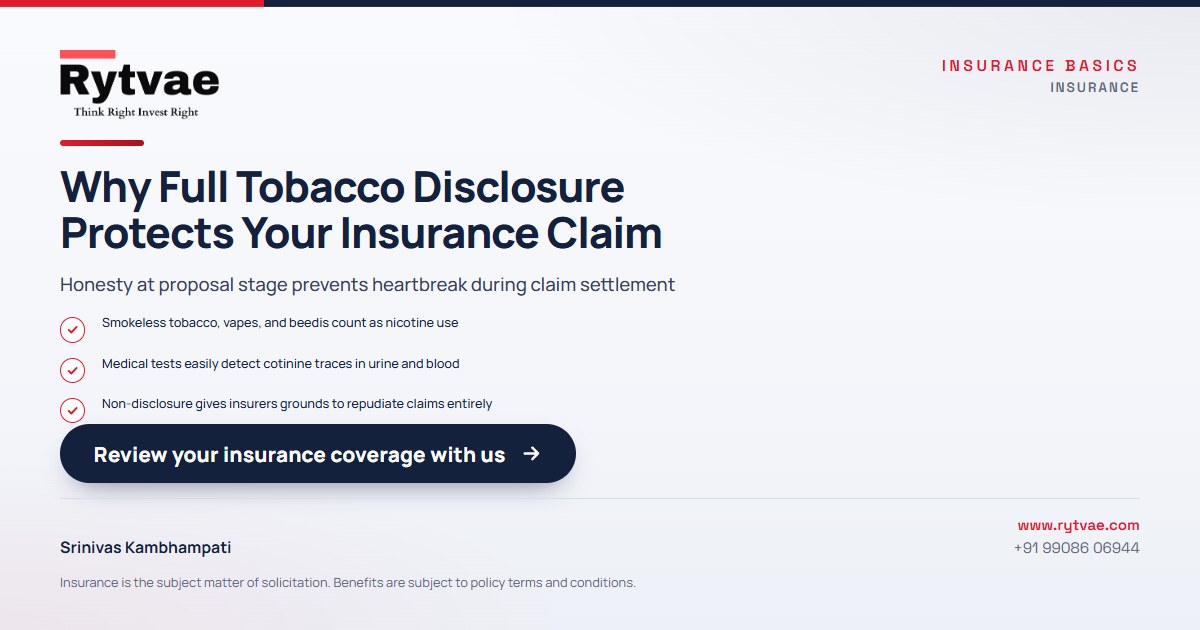
When you sit down to fill out a proposal form for life or health insurance, the question about smoking and tobacco consumption often brings hesitation. Many individuals wonder whether an occasional cigarette at a social gathering, a celebratory cigar, or the use of smokeless chewing tobacco really needs to be reported. The temptation to check the non-smoker box to save on premium charges can be strong.
However, doing so undermines the very purpose of purchasing an insurance policy. A policy purchased with incomplete or inaccurate declarations provides a false sense of security. If a claim arises, non-disclosure can lead to an outright repudiation, leaving your nominees without the financial safety net you planned to build.
What Insurers Define as Tobacco and Nicotine Use
In insurance underwriting, the classification of a tobacco user is broader than most applicants realize. Underwriters evaluate total nicotine exposure and systemic health risk rather than the social frequency of the habit. From an insurer's standpoint, tobacco usage is not restricted solely to regular cigarette smoking.
You must declare consumption if you use any of the following items:
- Manufactured cigarettes and hand-rolled beedis
- Pipes, cigars, and cigarillos
- Chewing tobacco, gutkha, khaini, and pan masala containing tobacco
- Nicotine replacement therapies such as nicotine gums, transdermal patches, or inhalers
- Electronic nicotine delivery systems, including vapes and e-cigarettes
- Hookah or shisha, regardless of how rarely it is consumed
If you consume nicotine in any form, insurers expect you to state it clearly. The underwriting department evaluates the risk profile of nicotine consumption based on biological impact rather than social context. Whether establishing personal cover through life insurance plans in India or reviewing coverage through an employer, transparency is the bedrock of valid protection.
How Medical Underwriting Detects Nicotine Exposure
When applying for high-sum-assured term life insurance or comprehensive health insurance, underwriters frequently mandate pre-policy medical check-ups. Even if a physical medical test is waived due to your age or chosen coverage level, medical records gathered during a future claim investigation can reveal past health habits.
During pre-issuance health tests, insurers routinely conduct a urine cotinine test. Cotinine is a chemical byproduct formed after nicotine enters the body. While nicotine itself leaves the bloodstream relatively quickly, cotinine remains detectable in urine, blood, and saliva for several days, and sometimes longer in habitual consumers. A positive cotinine screen immediately classifies an applicant as a tobacco user, regardless of what was written on the proposal form.
If a discrepancy appears between the proposal declaration and the medical report, the insurer may decline the application outright or issue a revised counter-offer with revised underwriting conditions and loaded premiums. Attempting to conceal the habit during the application stage creates an immediate question of good faith.
The Long-Term Impact on Life and Health Insurance Claims
The principle of utmost good faith (uberrima fides) governs every insurance contract in India. Both parties—the policyholder and the insurer—are required to disclose all material facts that could influence the decision to accept or price the risk. Tobacco consumption is universally treated as a material fact because it directly correlates with increased cardiovascular, respiratory, and oncological risks.
If an applicant states they are a non-smoker but passes away during the policy term, the insurer's claims department conducts an investigation. If hospital records, attending physician statements, or forensic findings reveal a history of chronic nicotine or tobacco consumption, the insurer holds the legal right to reject the claim based on the non-disclosure of material facts. While structuring core family safeguards, such as those described in our guide on building unbreakable wealth foundations, avoiding non-disclosure is the most vital step in protecting your dependants.
| Factor | Full Tobacco Disclosure | Non-Disclosure (Concealed Habit) |
|---|---|---|
| Initial Premium | Reflects smoker mortality rates | Standard non-smoker rates |
| Underwriting Decision | Assessed transparently with clear terms | Based on incomplete risk evaluation |
| Medical Test Outcome | Consistent with proposal details | Discrepancies trigger re-evaluation or rejection |
| Claim Settlement | Honoured based on declared terms and exclusions | High risk of claim repudiation for fraud or suppression |
| Family Financial Protection | Secure and dependable | Severely compromised |
Quitting Tobacco: How Insurers View Past Habits
Many individuals successfully stop using tobacco and wonder how to represent their status. Most insurance companies require an applicant to be entirely nicotine-free for a continuous period—frequently between twelve and twenty-four months—before considering them eligible for non-smoker premium rates. Each insurer sets specific criteria regarding cessation periods.
If you quit six months ago, you must still declare that you were a tobacco user and specify your cessation date. The underwriter will determine whether you qualify for non-smoker terms immediately or need to be underwritten as a tobacco user until the required cessation milestone is achieved. If you are already holding a policy as a declared smoker and remain nicotine-free for several years, some insurers allow you to request a re-assessment, supported by fresh medical underwriting, to adjust future premiums.
The same discipline applies when reviewing personal or family health coverage. Whether you are securing a standalone policy or a health insurance family floater in India, truthful declarations ensure that your hospitalization benefits remain intact during acute medical emergencies.
The Practical Path Forward
Paying a higher premium as a declared tobacco user is an honest assessment of biological risk. It ensures that the contract you hold is robust, legally sound, and capable of delivering financial support when your nominees need it most. When evaluating personal policies or corporate provisions, conducting a broader financial health check-up in India helps clarify where your risk management stands and ensures every document reflects absolute factual accuracy.
Frequently asked questions
Do I need to declare smoking if I only smoke occasionally at social events?
Yes. Insurers do not distinguish between social smoking and daily smoking during the initial classification. Any nicotine consumption must be declared on the proposal form to ensure full transparency.
What happens if a medical test shows nicotine traces after declaring non-smoker status?
The underwriter will flag the discrepancy between your declaration and medical findings. The insurer may decline the proposal entirely or offer revised terms with significant premium loading based on smoker risk.
Can I change my policy status to non-smoker if I quit after buying the cover?
Some insurers allow existing policyholders to request a re-classification after proving continuous cessation for a specified period, typically twelve to twenty-four months. This process generally requires fresh medical tests and underwriter approval.
Does chewing tobacco count as a tobacco habit for term insurance?
Yes. Smokeless tobacco products such as khaini, gutkha, and pan masala contain nicotine and pose documented health risks. Insurers treat smokeless tobacco users under the tobacco-user category.
Srinivas Kambhampati — AMFI Registered Mutual Fund Distributor (ARN-265474), EUIN E091320. Insurance is the subject matter of solicitation. The benefits described are indicative and are governed entirely by the policy wording, terms, conditions and exclusions of the issuing insurer. Please read the policy document before concluding a sale. Srinivas Kambhampati, IRDAI-certified POSP, SSID-134076, attached to Policy Boss, working under the brand Rytvae Consulting, does not underwrite risk or settle claims.
See our full disclosures and disclaimers.