
Rytvae Consulting — AMFI Registered Mutual Fund Distributor (ARN-265474), EUIN E091320
The Financial Purpose of Life Insurance: Income Replacement, Debt Protection, and Family Stability
Life insurance is fundamentally a risk-management tool designed to replace economic earning power and secure family liabilities. Learn why treating life insurance as an investment often creates an underinsurance trap, and how to evaluate pure protection for long-term household security.
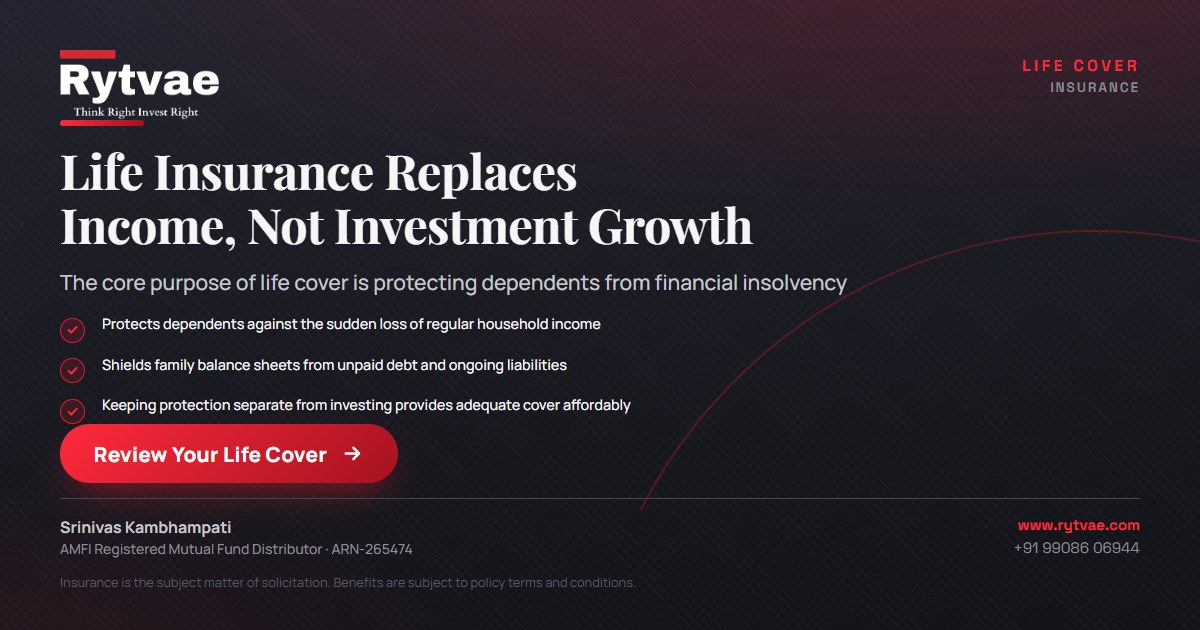
Many earning individuals in India pay substantial insurance premiums every year while remaining severely underinsured. The confusion usually stems from treating life insurance as a wealth accumulation product or a tax-saving exercise, rather than a catastrophic risk mitigation contract.
When life insurance is purchased primarily for maturity payouts or bonuses, the primary objective is missed: ensuring that dependents can sustain their standard of living and service ongoing obligations if the household's primary income stops abruptly.
The Concept of Human Life Value and Economic Loss
From a financial standpoint, an earning individual represents an economic asset to their dependents. Over a typical career spanning several decades, your earning power translates into regular cash flows that fund daily living expenses, household rent or maintenance, children's education, medical needs, and long-term savings goals.
If an untimely death occurs, that future stream of cash flows permanently ceases. The emotional loss is immeasurable, but the financial consequence is quantifiable: the loss of the individual's Human Life Value (HLV). The fundamental purpose of life insurance is not to enrich the surviving family, but to replace that lost economic contribution so the family does not face financial distress alongside personal grief.
Understanding this distinction changes how you view policy contracts. When exploring life insurance plans in India, the core parameter to evaluate is the adequacy of the sum assured relative to the family's ongoing living requirements, rather than the maturity benefits offered at the end of the term.
Replacing Future Cash Flows and Clearing Household Liabilities
A resilient household balance sheet must account for both immediate encumbrances and long-term commitments. In modern households, life insurance performs two vital financial functions upon the death of an earner:
- Debt and liability extinguishment: Home loans, personal borrowings, education loans, and business liabilities do not disappear when an earner passes away. Without adequate liquid cover, surviving dependents may be forced to liquidate residential property or distress-sell productive assets to settle bank claims. Life insurance proceeds provide immediate liquidity to clear debt entirely.
- Funding day-to-day sustenance: Beyond debt payoff, the family requires a reliable capital pool. When invested in conservative, income-generating instruments, this capital base must generate sufficient periodic cash flow to meet everyday groceries, utility bills, school fees, and healthcare inflation.
Without sufficient coverage, families are often forced to compromise on critical life milestones, such as discontinuing higher education or exhausting retirement funds accumulated by a surviving spouse.
The Costly Flaw in Bundling Protection with Investment
A common error across Indian households is buying endowment policies, money-back plans, or unit-linked contracts with modest sums assured under the belief that they combine safety with wealth creation. Bundling risk cover with capital growth often leads to sub-optimal outcomes on both fronts: the coverage remains too small to protect the family, and the returns may fail to outpace inflation after policy charges are deducted.
When you decouple risk protection from wealth creation, you can obtain a very large sum assured through pure term insurance at a manageable premium cost. The surplus funds can then be directed into transparent, growth-oriented avenues based on your specific risk profile and time horizon.
| Feature | Pure Term Risk Cover | Bundled Insurance-cum-Investment |
|---|---|---|
| Primary Purpose | Income replacement and pure mortality protection | Compulsory savings bundled with modest mortality cover |
| Coverage Scale | High sum assured for a relatively low premium cost | Low sum assured for a significantly higher premium cost |
| Maturity Value | Zero payout if the policyholder survives the term | Predetermined survival benefit or market-linked fund value |
| Liquidity & Transparency | Clear, straightforward contract with no investment charges | Surrender penalties, lock-in terms, and operational deductions |
As discussed in our analysis on building unbreakable wealth foundations with emergency funds and term cover, maintaining clear boundaries between insurance and investments prevents liquidity lock-ups and eliminates the underinsurance trap.
Sizing Your Life Cover: How Much Protection Is Enough?
There is no universal figure that fits every household, as insurance needs depend entirely on existing liabilities, current living expenditures, and future family dependencies. However, a reliable framework for estimating cover includes three components:
- Outstanding Liabilities: Add up all existing debt, including home loans, vehicle loans, and business borrowings.
- Income Replacement Pool: Calculate your household's annual living expenses (excluding your personal discretionary spending) and multiply this by the estimated number of years your family will rely on your earnings until financial self-sufficiency.
- Future Milestones: Account for unnegotiable capital outlays, such as higher education fees for minor children.
From this total gross requirement, subtract your household's existing liquid financial assets (excluding the family home and dedicated retirement assets). The resulting figure represents your net protection gap. Undergoing a structured financial health check-up allows you to review this gap annually as liabilities reduce or household expenses evolve.
Who Actually Needs Life Insurance?
Because the sole financial role of life insurance is replacing economic value, not everyone requires a policy. Life insurance is essential for individuals who have financial dependents who rely on their income—such as minor children, a non-earning spouse, or elderly parents with limited retirement resources.
Conversely, child insurance plans taken on the life of a minor child do not fulfill an income replacement function, because children do not have financial dependents or earned income. Similarly, retirees who have cleared all debts and whose children are financially independent rarely require substantial life insurance, as their focus shifts to capital preservation and regular cash flow rather than human capital protection.
Viewing life insurance through the lens of pure risk management ensures that every rupee committed to premiums directly protects your family's solvency, leaving your balance sheet uncompromised against unforeseen events.
Frequently asked questions
What is the primary financial purpose of life insurance?
The primary financial purpose of life insurance is to replace the economic value of an earning member upon their untimely demise. It ensures that surviving dependents can clear outstanding liabilities, meet recurring living expenses, and fund future milestones without liquidating essential household assets.
Why is pure term insurance preferred over traditional endowment policies for protection?
Pure term insurance charges premiums solely for mortality risk, allowing an individual to secure a substantially higher sum assured at an affordable cost. Traditional endowment plans bundle risk cover with savings, which often results in inadequate coverage levels relative to the household's actual income replacement needs.
Do retirees or individuals without dependents need life insurance?
Generally, individuals without financial dependents or active liabilities do not require life insurance because there is no future earned income to replace. Retirees whose children are financially settled usually need health cover and estate planning solutions rather than life cover.
How often should an individual review their life insurance coverage?
Life insurance coverage should be reviewed every two to three years or immediately following major life events, such as marriage, the birth of a child, taking on a significant home loan, or experiencing a major shift in household expenditure.
Rytvae Consulting — AMFI Registered Mutual Fund Distributor (ARN-265474), EUIN E091320. Insurance is the subject matter of solicitation. The benefits described are indicative and are governed entirely by the policy wording, terms, conditions and exclusions of the issuing insurer. Please read the policy document before concluding a sale. Rytvae Consulting acts as a distribution intermediary and does not underwrite risk or settle claims.
See our full disclosures and disclaimers.