
Term Insurance Versus Savings-Oriented Life Insurance: How to Protect Your Family Without Confusing Cover and Investments
Many households purchase traditional endowment or money-back policies expecting both protection and savings, only to find themselves severely underinsured. Here is how pure term insurance differs from savings-oriented life plans, and why separating the two matters.
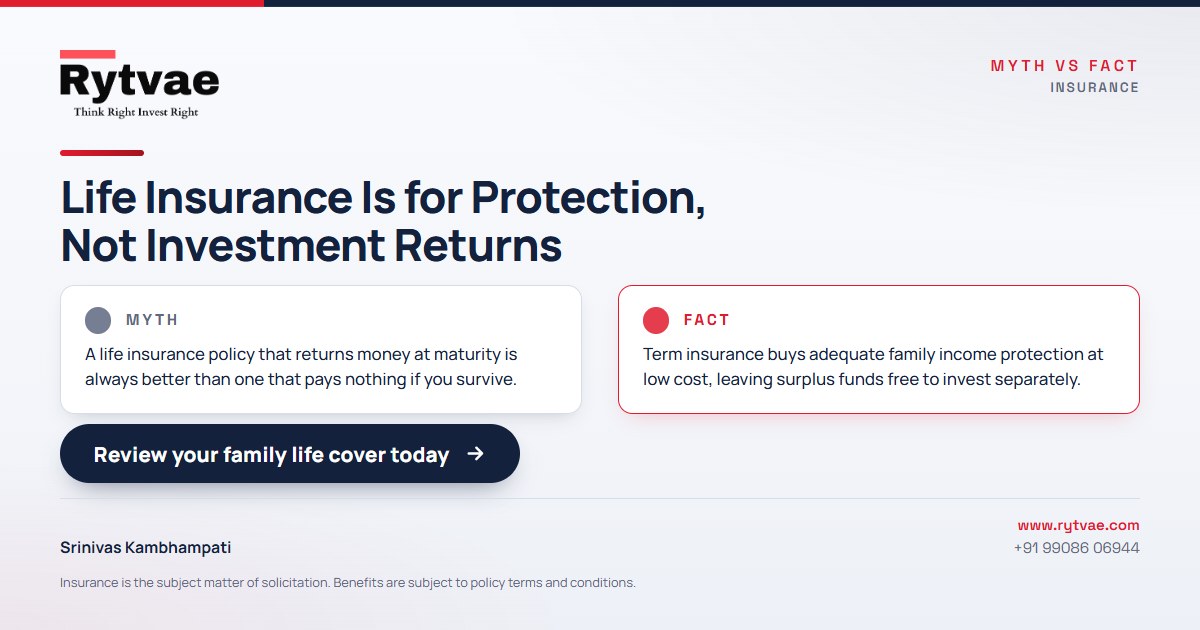
Many earning individuals buy a life insurance policy simply because an acquaintance or relative suggested an endowment plan that promises periodic payouts or a lump sum on maturity. You pay premiums for years, reassured by the belief that your family is fully protected while your money quietly accumulates for a future milestone.
The dilemma surfaces when you examine what that cover actually achieves if an unforeseen tragedy occurs. A policy with a maturity sum of five lakh or ten lakh rupees may feel substantial during annual premium payments, but for an urban Indian family facing living expenses, school fees, and long-term liabilities, that amount lasts only a few months or years. Bundling life protection with a savings pool often results in paying high annual premiums for an inadequate sum assured.
The Anatomy of Pure Risk Protection: How Term Insurance Works
Term insurance is a straightforward financial contract. You pay a specified premium to an insurer for a defined period, known as the policy term. If the insured individual passes away during that period, the insurer pays the agreed death benefit to the designated nominees. If the insured survives the term, the policy terminates, and no maturity value is returned.
Because the insurer does not need to accumulate an investment corpus or guarantee survival returns, almost the entire premium—aside from administrative, distribution, and underwriting costs—is allocated toward managing mortality risk. This structure allows an individual to secure a cover amounting to several multiples of their annual income for a modest annual outflow. For breadwinners seeking to safeguard their dependants against the complete loss of household cash flow, establishing pure cover through Life Insurance Plans in India provides a high-leverage safety net.
During the underwriting stage of any term policy, full transparency is mandatory. Accurately detailing medical history and personal habits is vital, as outlined in our guide on Tobacco Disclosure in Insurance: Why Honesty Matters, ensuring your family faces no hurdles during claim settlement.
The Mechanics of Savings-Oriented Life Insurance Policies
Savings-oriented life insurance plans—commonly sold as endowment policies, whole life plans, or money-back covers—combine life risk protection with an internal capital accumulation mechanism. When you remit a premium for these plans, the insurer divides the money into distinct portions: one portion goes toward mortality charges, another covers distribution and operational expenses, and the remaining portion enters the insurer's investment reserve.
These products appeal to a natural behavioral instinct: the reluctance to pay an expense without receiving a tangible monetary refund if the catastrophic event does not occur. However, maintaining investment reserves and issuing conservative bonuses requires significant capital. As a consequence, for the exact same annual premium that could secure comprehensive financial security under a pure term contract, a savings-oriented plan typically offers only a small fraction of the death benefit.
Key Structural Differences Compared
Evaluating these two approaches requires looking past marketing terminology to assess how each policy handles risk allocation, premium deployment, and liquidity.
| Feature | Pure Term Insurance | Savings-Oriented Insurance |
|---|---|---|
| Primary Purpose | Pure income replacement and catastrophic risk protection | Dual purpose: modest cover combined with conservative savings |
| Death Benefit Payout | Full sum assured paid to nominee upon demise during term | Sum assured plus accrued bonuses paid upon demise during term |
| Maturity Benefit | Nil (unless a specific return-of-premium variant is selected) | Lump sum or staggered payouts on surviving the policy term |
| Coverage Relative to Premium | High cover for a modest annual premium outlay | Low cover for a comparatively high annual premium outlay |
| Liquidity and Surrender | No surrender value; coverage ceases if premiums stop | Surrender value available after specified duration, subject to policy rules |
| Financial Role in Portfolio | Foundational safety net protecting family balance sheet | Fixed-income debt allocation with built-in partial life cover |
The Risk of Structural Underinsurance
The primary hazard of relying on savings-oriented plans for family protection is structural underinsurance. When households commit a substantial share of their annual surplus to endowment premiums, they often exhaust their insurance budget long before achieving the necessary coverage level.
If a household requires a cover calculated around fifteen to twenty times the annual living expenses plus outstanding liabilities, attempting to buy that quantum through traditional savings plans would require an impractical premium outlay. As a result, families compromise by buying a policy with a nominal cover that fits their budget. This leaves the dependents vulnerable to severe financial distress should the earning member pass away early in their working career.
Securing pure risk cover first prevents this shortfall. It establishes a resilient baseline as described in our review of Building Unbreakable Wealth Foundations: Emergency Funds, Term Cover & Hygiene, ensuring family obligations remain protected regardless of market conditions or career interruptions.
Separating Protection from Wealth Accumulation
A sound financial framework treats distinct financial objectives with dedicated instruments. Life insurance serves to mitigate the financial consequence of premature death. Wealth accumulation serves to fund planned life milestones, such as higher education, residential property purchase, and retirement.
When you decouple these two responsibilities, your financial life becomes transparent:
- Targeted Protection: You purchase a pure term policy that covers your earning years, scaled adequately to extinguish all liabilities, fund ongoing household expenses, and support your children until they are financially independent.
- Independent Capital Growth: The premium savings gained by choosing a term policy over a high-cost endowment plan are directed into appropriate savings and investment avenues tailored to your liquidity preferences, risk profile, and investment horizon.
- Operational Flexibility: In bundled policies, missing premium payments can lead to lapsed cover or penal surrender values. When insurance and investments are separate, modifying your investment contributions during lean periods does not jeopardize your family's basic mortality protection.
Evaluating whether your current coverage meets your actual family liabilities is a core component of a structured Financial Health Check-Up | Nine-Point Annual Review. Taking the time to calculate your family's realistic replacement income allows you to use insurance products for their true purpose: complete peace of mind through uncompromised protection.
Frequently asked questions
What happens if I outlive the policy tenure of a term insurance plan?
A standard term insurance policy pays no maturity benefit if the policyholder survives the chosen tenure. The premium paid serves purely to transfer mortality risk to the insurer during that period, similar to motor or health insurance.
Can I stop a savings-oriented life insurance plan if I realize the cover is inadequate?
Yes, but terminating a savings-oriented policy early usually entails a surrender cost governed by the insurer's policy terms. Before stopping any policy, you must ensure adequate pure term cover is already active so your family is never left unprotected.
How do I calculate the right life insurance coverage amount for my family?
Adequate cover should account for current household living expenses multiplied across the years dependents will need support, all outstanding personal or home liabilities, and major future milestones such as children's education.
Insurance is the subject matter of solicitation. The benefits described are indicative and are governed entirely by the policy wording, terms, conditions and exclusions of the issuing insurer. Please read the policy document before concluding a sale. Srinivas Kambhampati, IRDAI-certified POSP, SSID-134076, attached to PolicyBoss, working under the brand Rytvae Consulting, does not underwrite risk or settle claims.
See our full disclosures and disclaimers.