
Srinivas Kambhampati — AMFI Registered Mutual Fund Distributor (ARN-265474), EUIN E091320
Individual Health Insurance vs Family Floater Cover: How to Structure Household Protection
Choosing between individual mediclaim and a family floater is not just about upfront premium costs. Understand how pooled limits, age-band pricing, and cumulative bonuses shape your family's actual hospitalisation coverage.
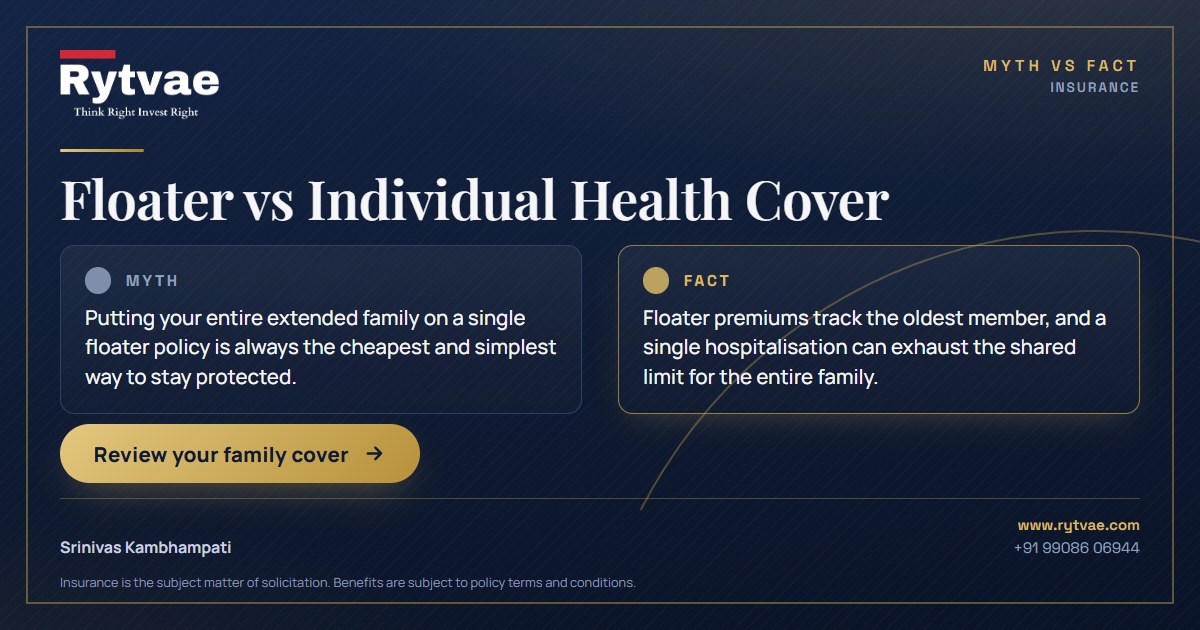
When planning household finances, bundling everyone into a single family floater health insurance policy often looks like an easy administrative decision. Many families combine parents, spouses, and children under one umbrella policy, assuming that a single, large sum insured will comfortably take care of any hospitalisation that arises during the year.
However, when a major illness strikes, the operational realities of an ill-fitted floater structure can create significant financial friction. If one family member undergoes a prolonged procedure that exhausts the shared sum insured, the remaining members may be left with little to no coverage for the remainder of the policy year unless an appropriate restoration benefit is available.
How the Two Policy Structures Operate
An individual health insurance policy assigns an independent, dedicated sum insured to a single person. If a policyholder holds a cover of ₹10 lakh, that entire ₹10 lakh is available exclusively for their medical events during that policy term. Even if multiple family members maintain individual policies with the same insurer, a claim filed by one individual has zero impact on the sum insured, cumulative bonus, or claims track record of the others.
A family floater policy pools the sum insured across all enrolled members. Under a ₹10 lakh floater covering two adults and two children, the entire family shares that single ₹10 lakh limit. If one member requires treatment costing ₹8 lakh, only ₹2 lakh remains available for the other three members for the rest of that policy year. While some modern policies offer restoration features, these clauses often come with restrictions, such as applying only to unrelated illnesses or kicking in only after the initial sum insured is completely exhausted.
The Core Trade-Offs: Age-Band Pricing and Claims Frequency
In retail health insurance, the premium for a family floater is calculated based on the age and risk profile of the oldest enrolled family member. This pricing mechanism introduces an important structural consideration for multi-generational Indian families.
If a 32-year-old individual adds their 64-year-old parent to a family floater alongside a spouse and young child, the premium for the entire combined policy is pegged to the 64-year-old's risk bracket. Furthermore, senior family members statistically experience a higher frequency of medical consultations, diagnostic procedures, and hospital admissions. When a senior parent files recurring claims under a pooled policy, the entire family risks losing the cumulative no-claim bonus (NCB), and the collective pool can be depleted quickly.
For those managing employer-provided covers, understanding this distinction is equally relevant. As discussed in our analysis of employee-only versus family-inclusive group health cover, relying solely on shared or group structures without private, ring-fenced individual protection can expose households to gaps during career transitions or retirement.
Direct Comparison: Individual Mediclaim vs Family Floater
| Feature | Individual Health Insurance | Family Floater Policy |
|---|---|---|
| Sum Insured Allocation | Dedicated to each named individual. | Shared across all enrolled family members. |
| Premium Basis | Calculated on the individual's specific age and health history. | Determined primarily by the age and risk of the oldest member. |
| Impact of a Claim | Reduces only the claimant's limit for that policy year. | Reduces the common pool available to all members. |
| Cumulative Bonus (NCB) | Maintained separately for each individual who makes no claim. | Lost or reduced for the entire household if any member claims. |
| Administrative Burden | Multiple renewal dates and policy documents to track. | Single policy document, one renewal date, and unified premium payment. |
| Ideal Use Case | Senior parents, members with chronic conditions, or independent adults. | Young couples and nuclear families with minor children. |
The Blended Household Strategy
Rather than choosing exclusively between one structure or the other, many households benefit from a segregated, hybrid approach. Evaluating your family structure as part of an overall financial health check-up helps identify where pooling risks makes sense and where independent coverage is essential.
- Separate Policies for Senior Parents: Keep parents on dedicated individual health insurance policies or senior-specific covers. This protects their personal sum insured from being drained by other household medical events, and prevents their age bracket from inflating the premiums of younger family members.
- A Floater for the Nuclear Unit: A young couple and their dependent children generally carry a lower statistical probability of multiple simultaneous hospitalisations. A combined floater works well here, offering convenient administration and cost efficiency.
- Standalone Covers for Individuals with Chronic Illnesses: If a family member manages a known condition such as diabetes or hypertension, placing them on an individual policy isolates their claim history and preserves the floater's no-claim benefits for the rest of the family.
Key Policy Clauses to Review Before Deciding
Regardless of which structure you choose through a comprehensive health insurance & family floater in India solution, several contractual conditions require careful examination:
First, review the waiting periods for pre-existing diseases and specific ailments. When migrating older parents from a floater to an individual policy, ensure that credit for continuity (portability of waiting periods) is maintained under regulatory guidelines.
Second, examine co-payment clauses and room rent sub-limits. Many policies linked to older entry ages mandate a proportional deduction or co-pay on every claim. Understanding these terms ensures that unexpected out-of-pocket expenses do not derail your emergency reserves.
Frequently asked questions
Can I move a parent from a family floater to an individual policy later?
Yes, you can port or separate a parent from a floater into an individual policy during renewal. Under regulatory continuity guidelines, accrued waiting-period credits for pre-existing conditions are generally preserved up to the existing sum insured.
What happens to a child covered under a family floater once they turn 25?
Most health insurance policies define dependent children up to a specific age threshold, commonly 25 years. Once a child reaches this age limit or becomes financially independent, they must transition into their own individual policy, carrying forward their waiting-period continuity.
Does a restoration benefit make a family floater as good as individual cover?
While restoration benefits reinstate exhausted sums insured, they often include conditions. Many policies only restore the sum insured for unrelated illnesses or activate the clause only after the primary limit is entirely exhausted, meaning it does not fully replace dedicated limits.
Srinivas Kambhampati — AMFI Registered Mutual Fund Distributor (ARN-265474), EUIN E091320. Insurance is the subject matter of solicitation. The benefits described are indicative and are governed entirely by the policy wording, terms, conditions and exclusions of the issuing insurer. Please read the policy document before concluding a sale. Srinivas Kambhampati, IRDAI-certified POSP, SSID-134076, attached to PolicyBoss, working under the brand Rytvae Consulting, does not underwrite risk or settle claims.
See our full disclosures and disclaimers.